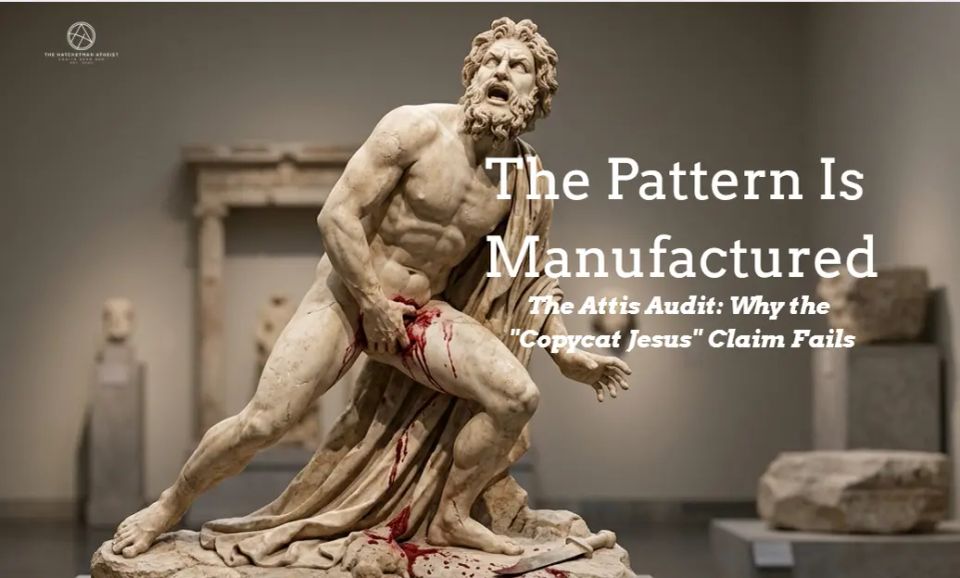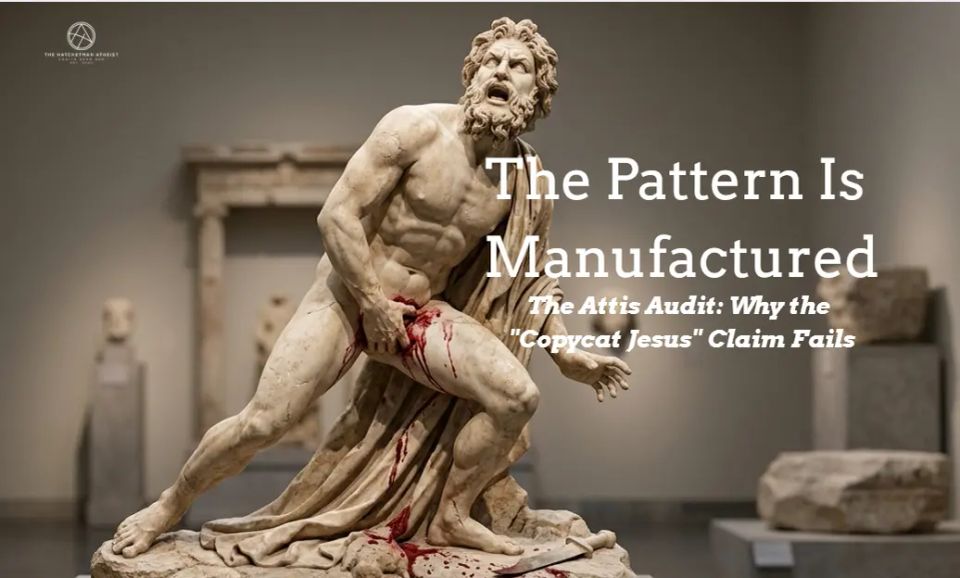
The Attis Audit: Why the “Copycat Jesus” Claim Fails
The Verdict: The Attis–Jesus parallel is manufactured. Sources for the “virgin birth” appear a century after the Gospels—borrowing cannot happen in reverse. Zeus explicitly refused to resurrect Attis; preservation is not resurrection. Click for the full forensic audit.
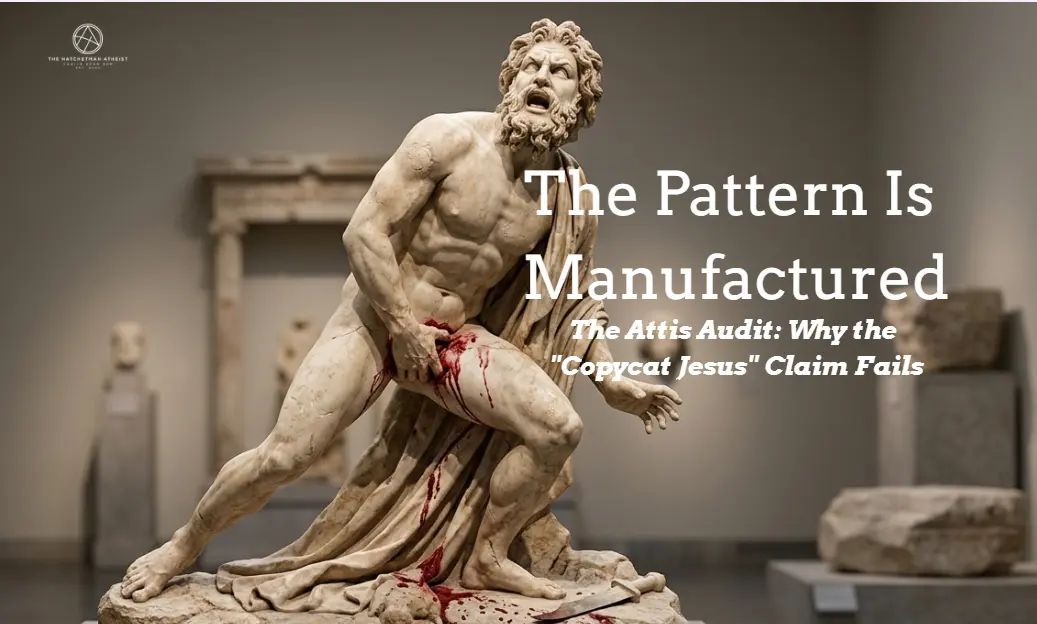
Audit Brief: The Attis–Jesus Comparison
The Verdict: The pattern is manufactured—produced by stripping context and rearranging the timeline.
The Timeline Trap: The birth story involving Nana—the supposed “virgin” parallel—does not appear until the mid-2nd century CE, nearly a century after the Gospels. A source cannot be copied before it exists.
The Resurrection Claim: In the primary account (Pausanias), Zeus explicitly refuses to restore Attis to life. The body is preserved from decay, but remains a corpse. Preservation is not resurrection.
Category Error: Proponents strip away ritual and historical context to force a cyclical nature myth to look like a linear historical legend.
Bottom Line: When a “parallel” appears a century late and only after reconstruction, it is not a source. It is coincidence—or adaptation.
For more in depth examination of how this myth is mischaracterized by modern “comparative religionists,” see:
• The Attis “Virgin Birth” Claim Exposed
• The Six Degrees of Jesus: How Context Shrinkage Manufactures Parallels
Inside This Audit
- Why the Jesus story is a "legend" and the Attis story is a "transformation chain."
- Why a 2nd-century birth story cannot be a 1st-century source.
- Analyzing Zeus’s refusal to restore life and the "corpse-persistence" motif.
- How "Context Shrinkage" is used to manufacture a fake pattern.
- Distinguishing ritual self-mutilation from Roman-style political execution.
- Appendix A: Tracking 16 distinct mythic elements across nine centuries of data.
Introduction: The Shape of a Manufactured Pattern
The claim that Jesus was copied from Attis usually arrives as a clean, persuasive list: virgin birth, divine son, death, resurrection. It looks precise. It feels convincing.
That is exactly the problem.
Clean lists are where bad history hides. They strip away context, collapse timelines, and assemble features that never existed together into a single, artificial figure. What looks like a pattern is often something else entirely—a reconstruction built after the fact.
To see that clearly, the comparison has to be taken apart under conditions it usually avoids.
What follows is not a summary. It is an audit.
What a Historical Audit Reveals About the Attis–Jesus Comparison
Most people assume Attis is a single, stable story. He is not. Ancient traditions are layered systems that develop over time. A figure like Attis does not enter the record fully formed with a fixed set of attributes. Instead, the tradition evolves across centuries. Early sources present one version, later texts introduce new elements, and still later interpretations reshape the figure again.
A historical audit forces those layers apart.
It asks three simple questions:
- What does each source actually say?
- When does each feature appear?
- How does that timeline compare to the Gospel accounts?
The third question is decisive. If a feature appears after the Gospel accounts are already in circulation, it cannot serve as their source. You cannot copy a source that does not exist yet. That is not a theological claim. It is a chronological constraint.
Without this method, it becomes easy to assemble a composite figure out of pieces that never coexisted. With it, the comparison is forced to operate within the limits of the evidence.
Myth vs. Legend: The Category Problem
Before Attis and Jesus can be compared, the categories themselves have to be defined. In common usage, the word “myth” is often treated as a synonym for “false story,” but that definition is analytically useless. It collapses fundamentally different narrative structures into a single label.
The Attis story does not behave like a biography. It behaves like a chain of transformations.
A myth is best understood as a narrative that operates outside concrete historical time and is structured around transformation. Its events are driven by divine action, metamorphosis, and symbolic processes. It explains patterns—of nature, of ritual, of cosmic order—rather than recounting events located in a datable historical frame.
A legend works differently. A legend places itself within history. It uses real geography as geography, situates events under identifiable rulers, and unfolds as a sequence of actions in linear time. Even when it includes miracles or theological claims, it presents itself as something that happened.
By that definition, the Jesus story is a legend. It is presented as a life lived under specific political authorities, in named locations, moving through a sequence of public events—teaching, conflict, arrest, and execution.¹ Whatever one concludes about the truth of those claims, the narrative itself is structured as history.
Attis is not structured that way. The Attis story does not attempt to place its events within a datable historical framework. It does not move through a sequence of public actions carried out under political authority. It operates according to a different logic entirely.
Attis is myth. Jesus is legend. Treating them as though they are the same kind of story is the first error that makes every other error possible.
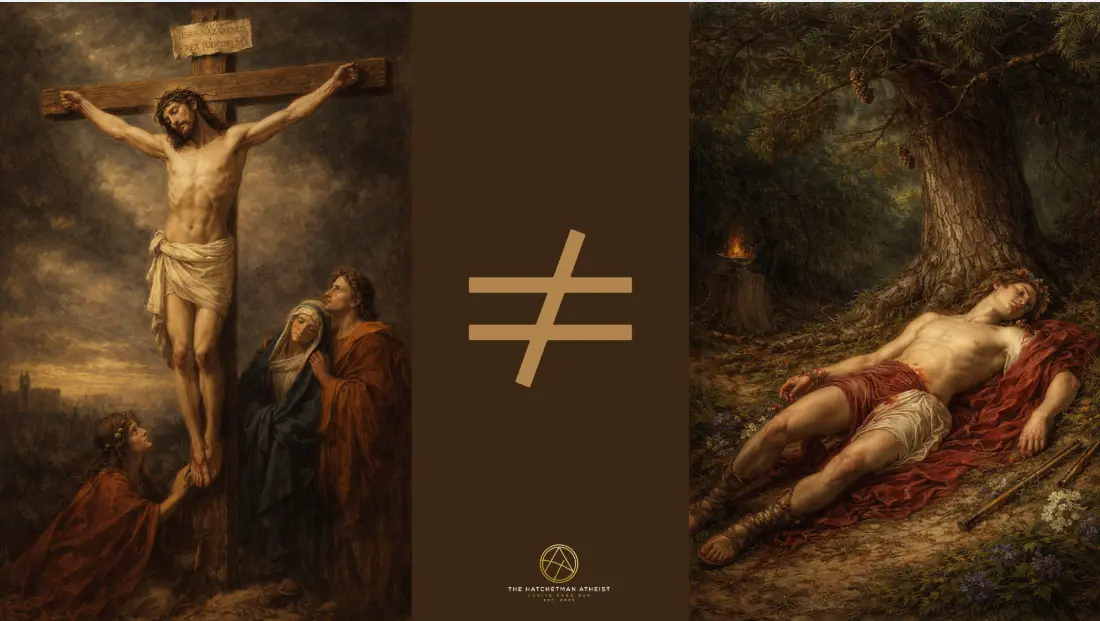
The Attis Story: A Compressed Overview
In the version of the myth preserved by Pausanias,² the story begins with a hermaphroditic being named Agdistis, a dangerous deity born from a rock. The gods fear Agdistis and decide to disable it. They get it drunk and tie its genitals to a tree. When it wakes and tries to stand, it accidentally castrates itself.²
The severed genitals fall to the ground. From that spot, a tree grows—usually an almond or pomegranate tree.
A nymph named Nana finds the tree and takes one of its fruits. She places the fruit in her lap or bosom, and it disappears into her body. There is no sex, no partner, and no divine visitation. The fruit simply vanishes, and she becomes pregnant.²
The child born from this process is Attis.
Caught in the Timeline Trap: The Attis "Virgin Birth" Lie
As an adult, Attis becomes involved with the cult of the mother goddess. At some point—depending on the version—he is driven into a state of divine madness. In that frenzy, he castrates himself under a tree and bleeds to death.
That is how he dies.
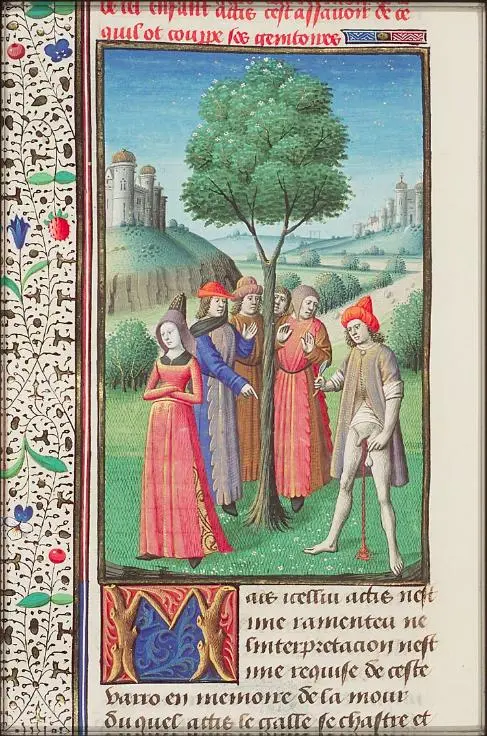
In the version reported by Pausanias, Zeus is asked to restore Attis to life—and refuses.² What follows is not resurrection but concession. The body is preserved. It does not decay. Later descriptions add small details: the hair continues to grow, there may be minimal movement. But nothing changes the central fact.
Attis does not return to life.
He does not act, speak, or reenter the world.
This is not resurrection. It is preservation.
He stays dead.
That detail matters.
The Six Degrees of Jesus: How Context Shrinkage Manufactures ParallelsThis version of the story is first recorded in the mid-second century CE. Earlier sources do not contain this full sequence of events. The birth narrative involving Nana and the fruit is absent in earlier material. The preserved, non-decaying body appears only in later descriptions. Other elements—such as the ritual framing and expanded mythic structure—also emerge at different points in the tradition.
What is often presented as a single story is not really a single story. It is a stack of different versions featuring the same characters, with new elements added over time. A useful analogy is modern comic book film universes. Spider-Man is always Peter Parker, but the details change—sometimes his girlfriend is Mary Jane, sometimes she is not; different relationships, different timelines, different storylines. Treating all of those versions as one continuous narrative would be a mistake. That is exactly what happens with Attis.
The Timeline Problem: Why Attis Cannot Be the Source of Jesus
Even if the structural differences are ignored, the chronology alone is enough to break the comparison.
The Gospel narratives are generally dated to the late first century. The more detailed Attis material used in modern comparisons—particularly the birth narrative—appears later, most clearly in second-century sources such as Pausanias.³
This creates a simple problem. The supposed parallels appear after the Jesus tradition is already in circulation.
That is not borrowing. It is backward projection.
A comparison built on reversed chronology cannot be sustained.
You cannot copy a source that does not exist yet.
The Full Claim Catalog
The comparison relies on a familiar set of recurring claims. These are the parallels that are usually alleged:
- miraculous or virginal birth on December 25
- divine sonship or being “fathered by a god”
- 12 disciples
- crucifixion
- resurrection (after three days)
Presented in list form, these claims look like a coherent pattern. But that appearance is the result of reduction.
Some of these features are absent from the Attis sources.⁴ Some appear only in later layers. Some are structurally different from what is claimed for Jesus. Others are created entirely through reinterpretation of symbolic material.
A detailed examination of how these claims are constructed—and how they are made to appear parallel—can be found here:
→ The Six Degrees of Jesus: How Context Shrinkage Manufactures Parallels
Why the Comparison Feels Convincing
For more on the true relationship of mythology and Christianity, see:
• https://www.the-hatchetman-atheist.com/jesus-vs-krishna-myth-debunked/
• https://www.the-hatchetman-atheist.com/dionysus-vs-jesus-myth/
• https://www.the-hatchetman-atheist.com/jesus-horus-myth-debunked/
The persistence of the Attis comparison is not due to the strength of the evidence but to the method used to construct it.
The defining features of the original story are removed. The symbolic system, the ritual context, and the narrative logic disappear. What remains is a set of vague elements: an unusual origin, a death, a continuation of some kind.
If you strip enough detail away, “a man died and something happened afterward” can describe almost any story. That is the level of comparison being used.
Once a story is reduced to that level, it can be forced to resemble almost anything.
This process can be called Context Shrinkage: the reduction of a narrative to generic components that can be rearranged and reinterpreted.
From there, each element is adjusted to match the target. A tree becomes a cross. Preservation becomes resurrection. Symbolic figures become disciples.
This is the Six Degrees of Jesus Fallacy. If enough detail is ignored, any figure can be made to resemble Jesus.
The pattern is not discovered. It is manufactured.
The Attis “Virgin Birth” Claim Exposed
The Audit Result
When the layers are separated and the timeline is enforced, the comparison collapses almost immediately. Many of the alleged similarities between Attis and Jesus do not appear in the historical record until long after the Gospel traditions are already in circulation. In some cases, the elements most useful to modern parallelists show up nearly a century later.³
That is the central problem.
The comparison depends on treating late-attested features as though they were already present in the earlier tradition. It takes details that emerge in different sources, at different times, and folds them backward into a synthetic Attis who never existed in any one version of the story.
Once that is done, the rest of the parallel can be staged. A mythic fertility narrative becomes a biography. Symbolic persistence becomes resurrection. Ritual symbolism becomes historical event. But none of that is coming from the sources themselves. It is coming from the way the material has been rearranged. This is not comparison. It is reconstruction.
The Attis tradition yields a mythic system centered on transformation, vegetation, and cyclical renewal. The Jesus tradition presents a figure operating within a historical framework, whose death and claimed return are treated as events within that framework.
These are not variations of the same story. They are different narrative systems.
Conclusion
The copycat argument only survives by ignoring the controls that historical comparison requires.
It does not survive contact with the sources. It survives the removal of them.
It requires myth and legend to be treated as identical, layered traditions to be flattened into a single account, ritual to be mistaken for narrative, and chronology to be ignored.
Once those controls are restored, the result is not ambiguous.
The comparison does not weaken.
It becomes impossible.
Appendix A: The Attis Tradition by Source Layer
This appendix breaks the Attis tradition into its major historical layers. Each source is evaluated against the same set of story elements. If an element does not appear in a given source, it is marked explicitly as absent. If a layer positively contradicts an element, that is stated directly.
Story Elements Tracked
- Miraculous or unusual birth
- Birth on December 25
- Divine conception / “fathered by a god”
- Nana and the fruit conception
- Association with Agdistis
- Status as divine or semi-divine being
- Status as a mortal prince (son of a king)
- Followers or disciples
- Death by castration
- Death associated with a tree
- Crucifixion
- Bodily resurrection
- Resurrection after three days
- Body preserved / does not decay
- Post-death activity (movement, animation, continued bodily persistence)
- Ritual mourning and celebration cycle
Layer 1 — Herodotus (~5th century BCE)
Miraculous or unusual birth — Absent
Birth on December 25 — Absent
Divine conception / “fathered by a god” — Absent
Nana and the fruit conception — Absent
Association with Agdistis — Absent
Status as divine or semi-divine being — Absent; Attis is presented as mortal
Status as a mortal prince (son of a king) — Present
Followers or disciples — Absent
Death by castration — Absent
Death associated with a tree — Absent
Crucifixion — Absent
Bodily resurrection — Absent
Resurrection after three days — Absent
Body preserved / does not decay — Absent
Post-death activity — Absent
Ritual mourning and celebration cycle — Absent
Layer 2 — Catullus, Poem 63 (~1st century BCE)
Miraculous or unusual birth — Absent
Birth on December 25 — Absent
Divine conception / “fathered by a god” — Absent
Nana and the fruit conception — Absent
Association with Agdistis — Absent by name; Cybele/Magna Mater framework is present
Status as divine or semi-divine being — Not clearly presented; Attis functions as a human devotee, not as a divine son
Status as a mortal prince (son of a king) — Absent
Followers or disciples — Absent
Death by castration — Absent as a completed death; self-castration is present, but Attis survives in the poem
Death associated with a tree — Present as background/forest setting, not as cause
Crucifixion — Absent
Bodily resurrection — Absent
Resurrection after three days — Absent
Body preserved / does not decay — Absent
Post-death activity — Absent
Ritual mourning and celebration cycle — Absent
Layer 3 — Pausanias (~150–175 CE)
Miraculous or unusual birth — Present
Birth on December 25 — Absent
Divine conception / “fathered by a god” — Indirectly present only in the sense of a mythic chain; there is no direct divine father
Nana and the fruit conception — Present
Association with Agdistis — Present
Status as divine or semi-divine being — Present in mythic form
Status as a mortal prince (son of a king) — Absent
Followers or disciples — Absent
Death by castration — Present
Death associated with a tree — Present as background setting, not cause
Crucifixion — Absent
Bodily resurrection — Absent; Zeus refuses restoration to life
Resurrection after three days — Absent
Body preserved / does not decay — Present
Post-death activity — Present in limited form: the preserved-body tradition includes continued hair growth and slight bodily persistence, not restored life
Ritual mourning and celebration cycle — Absent
Layer 4 — Arnobius (~late 3rd to early 4th century CE)
Miraculous or unusual birth — Present in late mythic form
Birth on December 25 — Absent
Divine conception / “fathered by a god” — The late birth tradition is present, but there is still no direct divine father in a biological or historical sense
Nana and the fruit conception — Present
Association with Agdistis — Present
Status as divine or semi-divine being — Present within the pagan mythic framework
Status as a mortal prince (son of a king) — Absent
Followers or disciples — Absent
Death by castration — Present
Death associated with a tree — Present as part of the mythic setting/tradition, not as an instrument of execution
Crucifixion — Absent
Bodily resurrection — Absent
Resurrection after three days — Absent
Body preserved / does not decay — Present
Post-death activity — Present only in the limited preserved-body sense: incorruptibility, continued hair growth, slight persistence; no return to life
Ritual mourning and celebration cycle — Present in relation to the later cultic complex
Layer 5 — Roman Festival / Hilaria Layer (imperial and late antique ritual attestations)
Miraculous or unusual birth — Absent
Birth on December 25 — Absent
Divine conception / “fathered by a god” — Absent
Nana and the fruit conception — Absent
Association with Agdistis — Not central / generally absent in ritual framing
Status as divine or semi-divine being — Attis is treated as a cult figure within ritual observance
Status as a mortal prince (son of a king) — Absent
Followers or disciples — Absent
Death by castration — Not narrated as a fresh story element in ritual form
Death associated with a tree — Present through the sacred tree rite, but ritual-symbolic rather than narrative-causal
Crucifixion — Absent
Bodily resurrection — Absent
Resurrection after three days — Absent
Body preserved / does not decay — Absent as a ritual claim
Post-death activity — Absent
Ritual mourning and celebration cycle — Present
Observations
The Herodotus layer does not give a mythic fertility god at all. It gives a mortal prince, the son of a king. That is not an early version of the later story so much as a fundamentally different character profile sharing the same name.
The Catullus layer introduces self-castration and ecstatic devotion, but not the later birth narrative, not resurrection, and not the Roman mourning/celebration cycle.
The Pausanias layer is where the developed birth story appears. It is also where the preserved-body motif becomes central. But even here, Zeus refuses resurrection. The body is preserved; Attis does not come back to life.
The Arnobius layer preserves the late mythic form, but still does not give crucifixion, disciples, or resurrection after three days.
The Roman ritual layer is where mourning followed by celebration belongs. That sequence is ritual, not biography, and not a resurrection narrative.
No single layer contains the full package claimed by modern parallelists. The alleged similarities are distributed across different sources, different centuries, and different kinds of material. What gets presented online as one story is actually a composite assembled from mutually non-identical layers.
Footnotes
General reference to the Gospel narratives situating Jesus within a historical framework.
Pausanias, Description of Greece 7.17.10–12.
Pausanias (2nd century CE) compared with first-century Gospel traditions.
See Appendix A.
Works Cited (MLA)
Arnobius. Against the Nations. Translated by George E. McCracken, Newman Press, 1949.
Catullus. The Poems of Catullus. Translated by Peter Green, University of California Press, 2005.
Herodotus. The Histories. Translated by Aubrey de Sélincourt, revised by John Marincola, Penguin Books, 2003.
Pausanias. Description of Greece. Translated by W. H. S. Jones and H. A. Ormerod, Harvard University Press, 1918.
Roller, Lynn E. In Search of God the Mother: The Cult of Anatolian Cybele. University of California Press, 1999.
Audit Brief: The Attis–Jesus Comparison
The Verdict: The pattern is manufactured—produced by stripping context and rearranging the timeline.
The Timeline Trap: The birth story involving Nana—the supposed “virgin” parallel—does not appear until the mid-2nd century CE, nearly a century after the Gospels. A source cannot be copied before it exists.
The Resurrection Claim: In the primary account (Pausanias), Zeus explicitly refuses to restore Attis to life. The body is preserved from decay, but remains a corpse. Preservation is not resurrection.
Category Error: Proponents strip away ritual and historical context to force a cyclical nature myth to look like a linear historical legend.
Bottom Line: When a “parallel” appears a century late and only after reconstruction, it is not a source. It is coincidence—or adaptation.
Introduction: The Shape of a Manufactured Pattern
The claim that Jesus was copied from Attis usually arrives as a clean, persuasive list: virgin birth, divine son, death, resurrection. It looks precise. It feels convincing.
That is exactly the problem.
Clean lists are where bad history hides. They strip away context, collapse timelines, and assemble features that never existed together into a single, artificial figure. What looks like a pattern is often something else entirely—a reconstruction built after the fact.
To see that clearly, the comparison has to be taken apart under conditions it usually avoids.
What follows is not a summary. It is an audit.
What a Historical Audit Reveals About the Attis–Jesus Comparison
Most people assume Attis is a single, stable story. He is not. Ancient traditions are layered systems that develop over time. A figure like Attis does not enter the record fully formed with a fixed set of attributes. Instead, the tradition evolves across centuries. Early sources present one version, later texts introduce new elements, and still later interpretations reshape the figure again.
A historical audit forces those layers apart.
It asks three simple questions. First, what does each source actually say? Second, when does each feature appear? Third, how does that timeline compare to the development of other traditions, in this case the Gospel accounts?
The third question is decisive. If a feature appears after the Gospel accounts are already in circulation, it cannot serve as their source. You cannot copy a source that does not exist yet. That is not a theological claim. It is a chronological constraint.
Without this method, it becomes easy to assemble a composite figure out of pieces that never coexisted. With it, the comparison is forced to operate within the limits of the evidence.
#xxxxxxxxxxx
Myth vs. Legend: The Category Problem
Before Attis and Jesus can be compared, the categories themselves have to be defined. In common usage, the word “myth” is often treated as a synonym for “false story,” but that definition is analytically useless. It collapses fundamentally different narrative structures into a single label.
The Attis story does not behave like a biography. It behaves like a chain of transformations.
A myth is best understood as a narrative that operates outside concrete historical time and is structured around transformation. Its events are driven by divine action, metamorphosis, and symbolic processes. It explains patterns—of nature, of ritual, of cosmic order—rather than recounting events located in a datable historical frame.
A legend works differently. A legend places itself within history. It uses real geography as geography, situates events under identifiable rulers, and unfolds as a sequence of actions in linear time. Even when it includes miracles or theological claims, it presents itself as something that happened.
By that definition, the Jesus story is a legend. It is presented as a life lived under specific political authorities, in named locations, moving through a sequence of public events—teaching, conflict, arrest, and execution.¹ Whatever one concludes about the truth of those claims, the narrative itself is structured as history.
Attis is not structured that way. The Attis story does not attempt to place its events within a datable historical framework. It does not move through a sequence of public actions carried out under political authority. It operates according to a different logic entirely.
Attis is myth. Jesus is legend. Treating them as though they are the same kind of story is the first error that makes every other error possible.
The Attis Story: A Compressed Overview
In the version of the myth preserved by Pausanias,² the story begins with a hermaphroditic being named Agdistis, a dangerous deity born from a rock. The gods fear Agdistis and decide to disable it. They get it drunk and tie its genitals to a tree. When it wakes and tries to stand, it accidentally castrates itself.²
The severed genitals fall to the ground. From that spot, a tree grows—usually an almond or pomegranate tree.
A nymph named Nana finds the tree and takes one of its fruits. She places the fruit in her lap or bosom, and it disappears into her body. There is no sex, no partner, and no divine visitation. The fruit simply vanishes, and she becomes pregnant.²
The child born from this process is Attis.
As an adult, Attis becomes involved with the cult of the mother goddess. At some point—depending on the version—he is driven into a state of divine madness. In that frenzy, he castrates himself under a tree and bleeds to death.
That is how he dies.
In the version reported bIy Pausanias, Zeus is asked to restore Attis to life—and refuses.² What follows is not resurrection but concession. The body is preserved. It does not decay. Later descriptions add small details: the hair continues to grow, there may be minimal movement. But nothing changes the central fact.
Attis does not return to life.
He does not act, speak, or reenter the world.
This is not resurrection. It is preservation.
He stays dead.
That detail matters.
This version of the story is first recorded in the mid-second century CE. Earlier sources do not contain this full sequence of events. The birth narrative involving Nana and the fruit is absent in earlier material. The preserved, non-decaying body appears only in later descriptions. Other elements—such as the ritual framing and expanded mythic structure—also emerge at different points in the tradition.
What is often presented as a single story is not really a single story. It is a stack of different versions featuring the same characters, with new elements added over time. A useful analogy is modern comic book film universes. Spider-Man is always Peter Parker, but the details change—sometimes his girlfriend is Mary Jane, sometimes she is not; different relationships, different timelines, different storylines. Treating all of those versions as one continuous narrative would be a mistake. That is exactly what happens with Attis.
The Timeline Problem: Why Attis Cannot Be the Source of Jesus
Even if the structural differences are ignored, the chronology alone is enough to break the comparison.
The Gospel narratives are generally dated to the late first century. The more detailed Attis material used in modern comparisons—particularly the birth narrative—appears later, most clearly in second-century sources such as Pausanias.³
This creates a simple problem. The supposed parallels appear after the Jesus tradition is already in circulation.
That is not borrowing. It is backward projection.
A comparison built on reversed chronology cannot be sustained.
You cannot copy a source that does not exist yet.
The Full Claim Catalog
The comparison relies on a familiar set of recurring claims. These are the parallels that are usually alleged:
- miraculous or virginal birth on December 25
- divine sonship or being “fathered by a god”
- 12 disciples
- crucifixion
- resurrection (after three days)
Presented in list form, these claims look like a coherent pattern. But that appearance is the result of reduction.
Some of these features are absent from the Attis sources.⁴ Some appear only in later layers. Some are structurally different from what is claimed for Jesus. Others are created entirely through reinterpretation of symbolic material.
A detailed examination of how these claims are constructed—and how they are made to appear parallel—can be found here:
→ The Six Degrees of Jesus: How Context Shrinkage Manufactures Parallels
Why the Comparison Feels Convincing
The persistence of the Attis comparison is not due to the strength of the evidence but to the method used to construct it.
The defining features of the original story are removed. The symbolic system, the ritual context, and the narrative logic disappear. What remains is a set of vague elements: an unusual origin, a death, a continuation of some kind.
If you strip enough detail away, “a man died and something happened afterward” can describe almost any story. That is the level of comparison being used.
Once a story is reduced to that level, it can be forced to resemble almost anything.
This process can be called Context Shrinkage: the reduction of a narrative to generic components that can be rearranged and reinterpreted.
From there, each element is adjusted to match the target. A tree becomes a cross. Preservation becomes resurrection. Symbolic figures become disciples.
This is the Six Degrees of Jesus Fallacy. If enough detail is ignored, any figure can be made to resemble Jesus.
The pattern is not discovered. It is manufactured.
The Audit Result
When the layers are separated and the timeline is enforced, the comparison collapses almost immediately. Many of the alleged similarities between Attis and Jesus do not appear in the historical record until long after the Gospel traditions are already in circulation. In some cases, the elements most useful to modern parallelists show up nearly a century later.³
That is the central problem.
The comparison depends on treating late-attested features as though they were already present in the earlier tradition. It takes details that emerge in different sources, at different times, and folds them backward into a synthetic Attis who never existed in any one version of the story.
Once that is done, the rest of the parallel can be staged. A mythic fertility narrative becomes a biography. Symbolic persistence becomes resurrection. Ritual symbolism becomes historical event. But none of that is coming from the sources themselves. It is coming from the way the material has been rearranged. This is not comparison. It is reconstruction.
The Attis tradition yields a mythic system centered on transformation, vegetation, and cyclical renewal. The Jesus tradition presents a figure operating within a historical framework, whose death and claimed return are treated as events within that framework.
These are not variations of the same story. They are different narrative systems.
Conclusion
The copycat argument only survives by ignoring the controls that historical comparison requires.
It does not survive contact with the sources. It survives the removal of them.
It requires myth and legend to be treated as identical, layered traditions to be flattened into a single account, ritual to be mistaken for narrative, and chronology to be ignored.
Once those controls are restored, the result is not ambiguous.
The comparison does not weaken.
It becomes impossible.
Appendix A: The Attis Tradition by Source Layer
This appendix breaks the Attis tradition into its major historical layers. Each source is evaluated against the same set of story elements. If an element does not appear in a given source, it is marked explicitly as absent. If a layer positively contradicts an element, that is stated directly.
Story Elements Tracked
Miraculous or unusual birth
Birth on December 25
Divine conception / “fathered by a god”
Nana and the fruit conception
Association with Agdistis
Status as divine or semi-divine being
Status as a mortal prince (son of a king)
Followers or disciples
Death by castration
Death associated with a tree
Crucifixion
Bodily resurrection
Resurrection after three days
Body preserved / does not decay
Post-death activity (movement, animation, continued bodily persistence)
Ritual mourning and celebration cycle
Layer 1 — Herodotus (~5th century BCE)
Miraculous or unusual birth — Absent
Birth on December 25 — Absent
Divine conception / “fathered by a god” — Absent
Nana and the fruit conception — Absent
Association with Agdistis — Absent
Status as divine or semi-divine being — Absent; Attis is presented as mortal
Status as a mortal prince (son of a king) — Present
Followers or disciples — Absent
Death by castration — Absent
Death associated with a tree — Absent
Crucifixion — Absent
Bodily resurrection — Absent
Resurrection after three days — Absent
Body preserved / does not decay — Absent
Post-death activity — Absent
Ritual mourning and celebration cycle — Absent
Layer 2 — Catullus, Poem 63 (~1st century BCE)
Miraculous or unusual birth — Absent
Birth on December 25 — Absent
Divine conception / “fathered by a god” — Absent
Nana and the fruit conception — Absent
Association with Agdistis — Absent by name; Cybele/Magna Mater framework is present
Status as divine or semi-divine being — Not clearly presented; Attis functions as a human devotee, not as a divine son
Status as a mortal prince (son of a king) — Absent
Followers or disciples — Absent
Death by castration — Absent as a completed death; self-castration is present, but Attis survives in the poem
Death associated with a tree — Present as background/forest setting, not as cause
Crucifixion — Absent
Bodily resurrection — Absent
Resurrection after three days — Absent
Body preserved / does not decay — Absent
Post-death activity — Absent
Ritual mourning and celebration cycle — Absent
Layer 3 — Pausanias (~150–175 CE)
Miraculous or unusual birth — Present
Birth on December 25 — Absent
Divine conception / “fathered by a god” — Indirectly present only in the sense of a mythic chain; there is no direct divine father
Nana and the fruit conception — Present
Association with Agdistis — Present
Status as divine or semi-divine being — Present in mythic form
Status as a mortal prince (son of a king) — Absent
Followers or disciples — Absent
Death by castration — Present
Death associated with a tree — Present as background setting, not cause
Crucifixion — Absent
Bodily resurrection — Absent; Zeus refuses restoration to life
Resurrection after three days — Absent
Body preserved / does not decay — Present
Post-death activity — Present in limited form: the preserved-body tradition includes continued hair growth and slight bodily persistence, not restored life
Ritual mourning and celebration cycle — Absent
Layer 4 — Arnobius (~late 3rd to early 4th century CE)
Miraculous or unusual birth — Present in late mythic form
Birth on December 25 — Absent
Divine conception / “fathered by a god” — The late birth tradition is present, but there is still no direct divine father in a biological or historical sense
Nana and the fruit conception — Present
Association with Agdistis — Present
Status as divine or semi-divine being — Present within the pagan mythic framework
Status as a mortal prince (son of a king) — Absent
Followers or disciples — Absent
Death by castration — Present
Death associated with a tree — Present as part of the mythic setting/tradition, not as an instrument of execution
Crucifixion — Absent
Bodily resurrection — Absent
Resurrection after three days — Absent
Body preserved / does not decay — Present
Post-death activity — Present only in the limited preserved-body sense: incorruptibility, continued hair growth, slight persistence; no return to life
Ritual mourning and celebration cycle — Present in relation to the later cultic complex
Layer 5 — Roman Festival / Hilaria Layer (imperial and late antique ritual attestations)
Miraculous or unusual birth — Absent
Birth on December 25 — Absent
Divine conception / “fathered by a god” — Absent
Nana and the fruit conception — Absent
Association with Agdistis — Not central / generally absent in ritual framing
Status as divine or semi-divine being — Attis is treated as a cult figure within ritual observance
Status as a mortal prince (son of a king) — Absent
Followers or disciples — Absent
Death by castration — Not narrated as a fresh story element in ritual form
Death associated with a tree — Present through the sacred tree rite, but ritual-symbolic rather than narrative-causal
Crucifixion — Absent
Bodily resurrection — Absent
Resurrection after three days — Absent
Body preserved / does not decay — Absent as a ritual claim
Post-death activity — Absent
Ritual mourning and celebration cycle — Present
Observations
The Herodotus layer does not give a mythic fertility god at all. It gives a mortal prince, the son of a king. That is not an early version of the later story so much as a fundamentally different character profile sharing the same name.
The Catullus layer introduces self-castration and ecstatic devotion, but not the later birth narrative, not resurrection, and not the Roman mourning/celebration cycle.
The Pausanias layer is where the developed birth story appears. It is also where the preserved-body motif becomes central. But even here, Zeus refuses resurrection. The body is preserved; Attis does not come back to life.
The Arnobius layer preserves the late mythic form, but still does not give crucifixion, disciples, or resurrection after three days.
The Roman ritual layer is where mourning followed by celebration belongs. That sequence is ritual, not biography, and not a resurrection narrative.
No single layer contains the full package claimed by modern parallelists. The alleged similarities are distributed across different sources, different centuries, and different kinds of material. What gets presented online as one story is actually a composite assembled from mutually non-identical layers.
Footnotes
- General reference to the Gospel narratives situating Jesus within a historical framework.
- Pausanias, Description of Greece 7.17.10–12.
- Pausanias (2nd century CE) compared with first-century Gospel traditions.
- See Appendix A.
Works Cited (MLA)
Arnobius. Against the Nations. Translated by George E. McCracken, Newman Press, 1949.
Catullus. The Poems of Catullus. Translated by Peter Green, University of California Press, 2005.
Herodotus. The Histories. Translated by Aubrey de Sélincourt, revised by John Marincola, Penguin Books, 2003.
Pausanias. Description of Greece. Translated by W. H. S. Jones and H. A. Ormerod, Harvard University Press, 1918.
Roller, Lynn E. In Search of God the Mother: The Cult of Anatolian Cybele. University of California Press, 1999.