Attis and the Virgin Birth: A Forensic Audit
Part 1: The Anatomy of a Vegetation God
The Mechanism of Chaos: Agdistis and the Tree
Claims that Jesus was copied from Attis often begin by pointing to supposed similarities in their origins, but those claims depend on ignoring how the Attis story actually works.
For more in depth examination of how this myth is mischaracterized by modern “comparative religionists,” see:
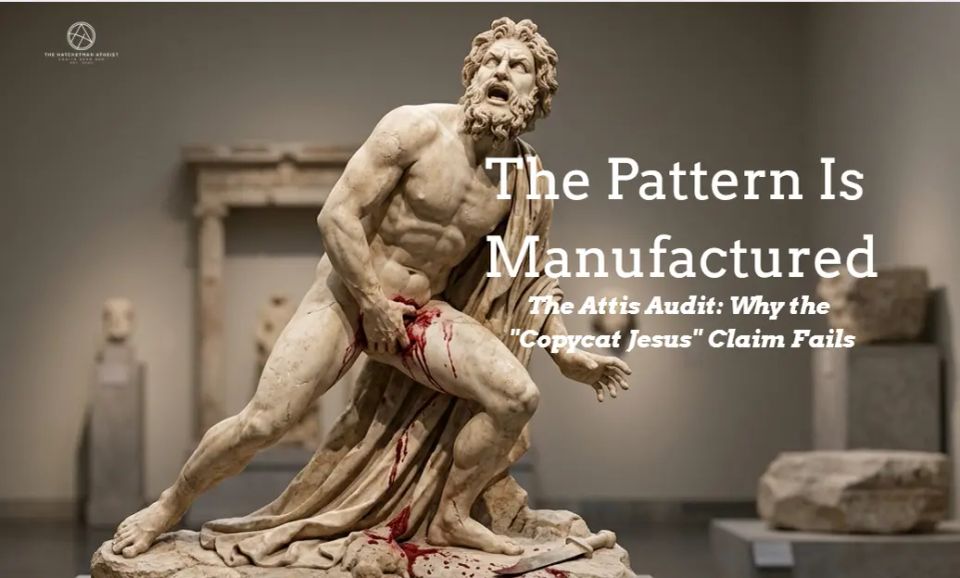
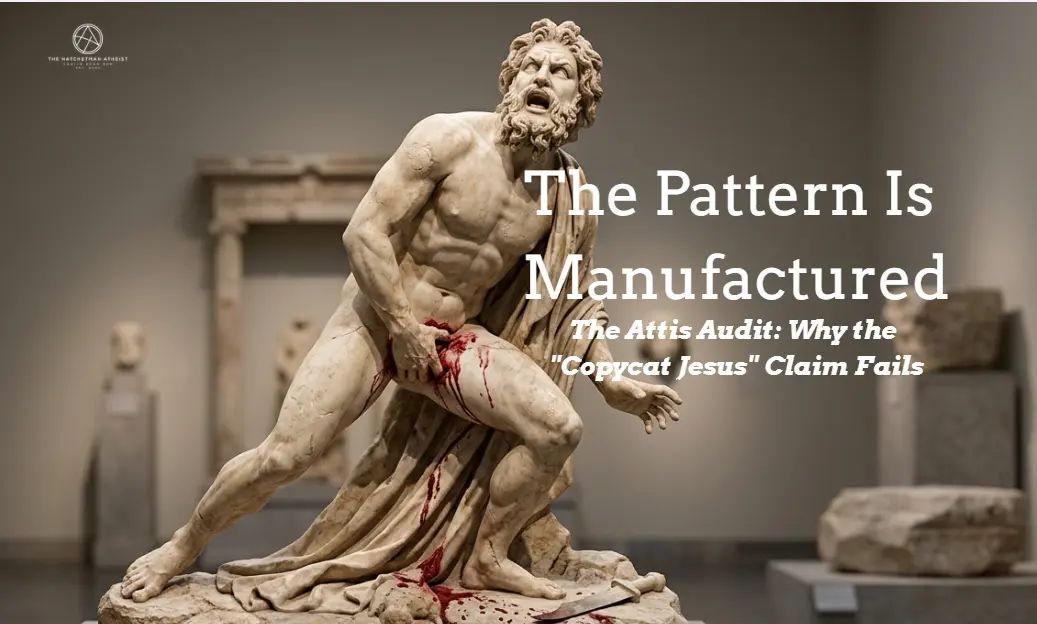
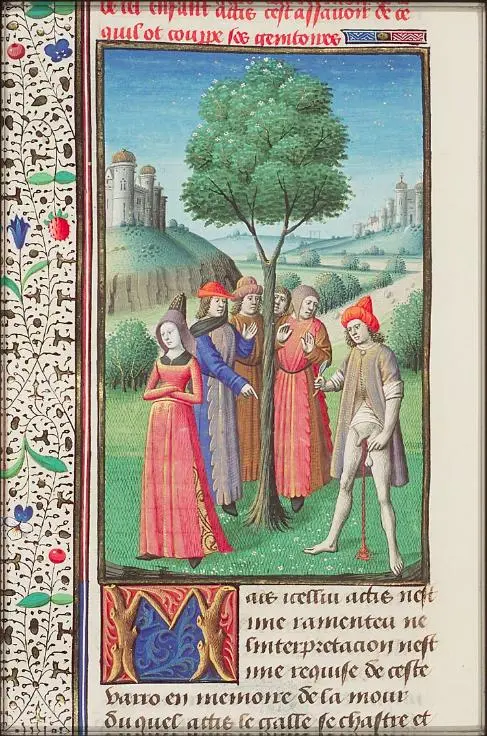
The Attis narrative does not begin with a birth. It begins with a violent act of divine self-mutilation. In the account preserved by Pausanias, the origin is a dual-sexed deity named Agdistis, born from a rock. To control this wild force, the gods drug Agdistis and tie its male genitals to a tree.
When it wakes and lunges, it tears itself apart. The flesh and blood from the severed member hit the ground—soaking into the earth—and from that exact spot a tree erupts into life: almond or pomegranate, depending on the version.
The Conception
Nana, a nymph and daughter of the river god Sangarius, finds the tree grown from the gore. She takes a fruit from the branches and places it in her bosom (her lap).
The fruit doesn't sit there; it vanishes instantly. Nana does not conceive through a biological event. She absorbs a product of divine blood.
No ancient source describes this as a virginal conception; that label is a modern redefinition created by flattening a complex fertility myth into a generic “miraculous birth."
The Layered Reproductive Chain
This structure is the point of the story. Nana isn't a "mother" in any historical sense; she is a conduit for a nature-process:
Divine Force: The chaotic power of Agdistis/Cybele.
The Gore: Severed flesh and blood hitting the earth.
The Plant: A tree erupting directly from that gore.
The Fruit: The seed Nana absorbs into her lap.
The Child: Attis.
The Six Degrees of Jesus: How Context Shrinkage Manufactures Parallels
The Code of Divine Parentage
For the auditor, "Divine Parentage" is a shorthand code. It is never a claim of historical fact. It serves two specific, mechanical functions:
To anchor the character in a mythic time and landscape. By tracing Attis back to a rock (Agdus) and a self-mutilating deity, the story signals that he is not a historical person. He is a permanent resident of the mythic realm, existing outside of datable history.
To symbolically link the character to an important real-world phenomenon. This chain—running from stone to blood to tree to fruit—links Attis directly to the vegetation cycle. He is the narrative expression of the seed. He does not "enter history" to save souls; he "emerges from the ground" to explain why the land dies in winter and returns in spring.
He is a botanical process, not a biographical subject. Nothing in this structure resembles a historical birth claim.
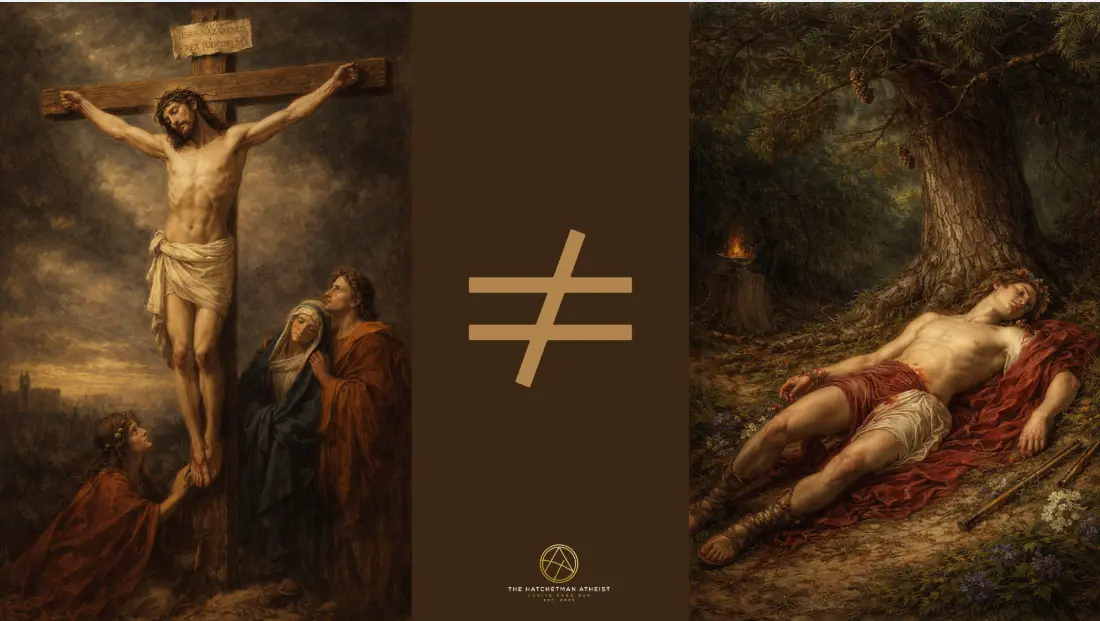
Closely related is the claim that Attis is “fathered by a god,” but this only works if the story is flattened beyond recognition. There is no divine father in any meaningful sense.
No god approaches Nana, no god impregnates her, no act of conception takes place. A mutilated deity bleeds into the ground, a tree grows from that blood, a piece of fruit is taken, and a child results from that chain. That is not fatherhood. That is a fertility mechanism.
Calling that “fathered by a god” is like calling a factory product the offspring of the man who built the machine that made it—it replaces a chain of processes with a single parent and hopes no one notices the difference.
Part 2: The Audit Verdict
What follows is an audit of the Attis comparison using primary sources and timeline controls.
The Chronological Bomb
We must be very clear and direct: **There is no evidence of any story regarding Attis' birth or parentage prior to Pausanias.**¹ Everything conspiracy theorists point to—the rock, the castration, the almond, and the nymph—comes from a single primary source: Pausanias.
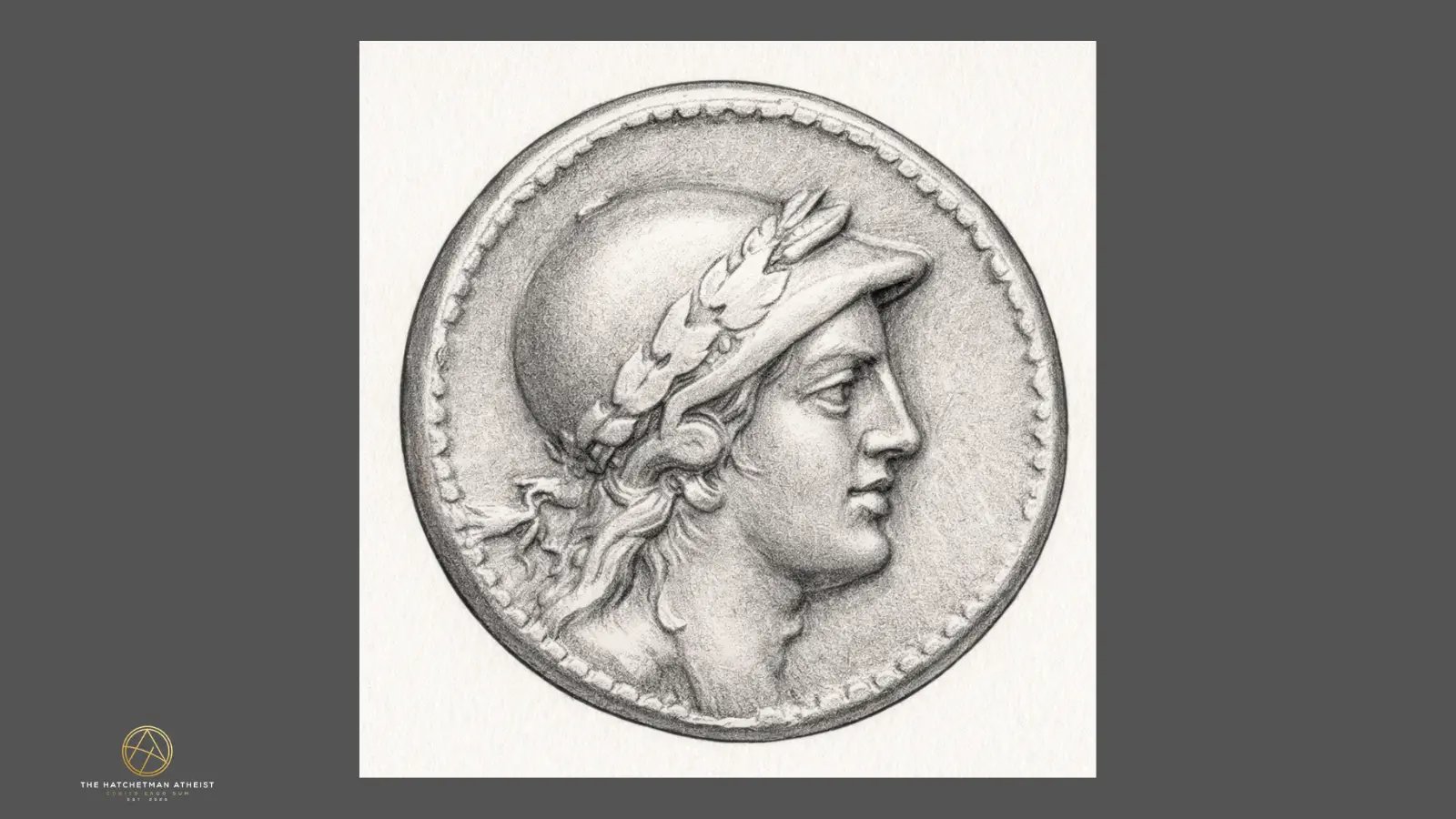
The Gospels (Matthew & Luke): Written and circulating between ~80–100 CE.
Pausanias (Description of Greece): Written between ~150–175 CE.²
The detailed birth of Attis is a Late Arrival. It post-dates the New Testament by 50 to 100 years. The ink on the Jesus story was already dry and the accounts fixed for nearly a century before this version of the Attis myth was even recorded.³ You cannot borrow a story from an author who won't be born for another fifty years.⁴
The Functional Divide: Symbology vs. History
This is where the categories separate cleanly. In mythic systems, unusual parentage is used to embed a figure in the structure of the natural world.⁵ Attis is a Symbological Anchor. His identity is inseparable from the processes he represents: fertility, seasonal cycles, and decay.
The Gospel claim is a Historical Claim. It is presented as a singular event in history with implications about identity and incarnation.
Attis is Cyclical: The story exists to explain a cycle that happens every year like the crops.
Jesus is Linear: The story is a "once for all" claim set in a datable timeline.
The "Scrap Metal" Fallacy
Conspiracy theorists engage in Semantic Stripping to make this parallel work. They have to peel away the rock, the blood, the almond, and the river nymph until they are left with the vague phrase "unusual birth."
It’s like stripping a car down until it’s just a pile of scrap metal and then claiming it’s "parallel" to a toaster because they both contain steel. If you have to destroy the context to make the comparison, the comparison is a lie.
Calling both of these “virgin births” requires collapsing a multi-stage fertility system into a historical-biological claim. That collapse is not analysis—it is the mechanism behind the Six Degrees of Jesus conspiracy: redefine terms, ignore chronology, and treat unrelated structures as equivalents.
Once the sources are separated, the structure is understood, and the timeline is respected, the parallel does not weaken—it disappears.
The same collapse occurs across the rest of the comparison—claims about disciples, crucifixion, and resurrection rely on the same method of stripping the story down until it no longer resembles the original.
The Attis–Jesus Copycat Historical Audit
Forensic Footnotes: Evidence & Source Audit
¹ Note 1: On the Herodotus Gap. The earliest written account of Attis appears in Herodotus (Histories 1.34–45), dating to the 5th century BC. In this foundational text, Attis is presented as a purely historical, mortal prince—the son of King Croesus. There is no mention of a dual-sexed deity, an almond, a nymph, or a miraculous birth. The "virgin birth" elements are entirely absent from the original Greek records.
² Note 2: On the 2nd-Century Appearance. The specific narrative of Nana and the almond is an epichorios logos (local legend) from Pessinus. While it may have existed in oral tradition, it does not enter the written historical record until Pausanias (Description of Greece 7.17.10–12) in the mid-2nd century CE. This creates a minimum 75-year gap between the fixation of the Gospel narratives and the first recorded appearance of the Attis birth details.
³ Note 3: Standard Roman Silence. During the 1st century BC—the era immediately preceding Jesus—the Roman poet Catullus (Poem 63) wrote the most famous Latin treatment of the Attis myth. Catullus focuses exclusively on Attis’ self-castration and devotion to Cybele. He makes no mention of a miraculous birth or divine parentage. This confirms that even during the Roman expansion of the cult, the "birth parallel" was not a recognized or emphasized feature of the myth.
⁴ Note 4: The Hearsay of Timotheus. Conspiracy theorists often claim the story is older because Pausanias credits a 3rd-century BC priest named Timotheus. However, in a forensic audit, this is classified as unverifiable hearsay. We possess zero surviving fragments of Timotheus’ writings. The "evidence" only exists as a 2nd-century AD report of what a 3rd-century BC man supposedly said. For the purpose of a historical audit, the date of the document is the only reliable control.
⁵ Note 5: Scholarly Consensus on Category Drift. Modern authorities on the Phrygian cults, such as M.J. Vermaseren (Corpus Cultus Cybelae Attidisque) and Jan Bremmer (Attis: A Greek God in Anatolian Pessinous), treat the Attis birth as an aetiological myth—a story designed to explain the origin of a specific ritual or botanical sacredness. They do not classify it as a "biographical birth" in the sense used by 1st-century Jewish or Roman historians.