Why Astronomical Odds Don’t Prove Design
Calculating odds sounds straightforward — until you realize that without knowing the full set of possibilities, how likely each is, and whether the process can be repeated, your numbers may be guesses dressed up as certainty.
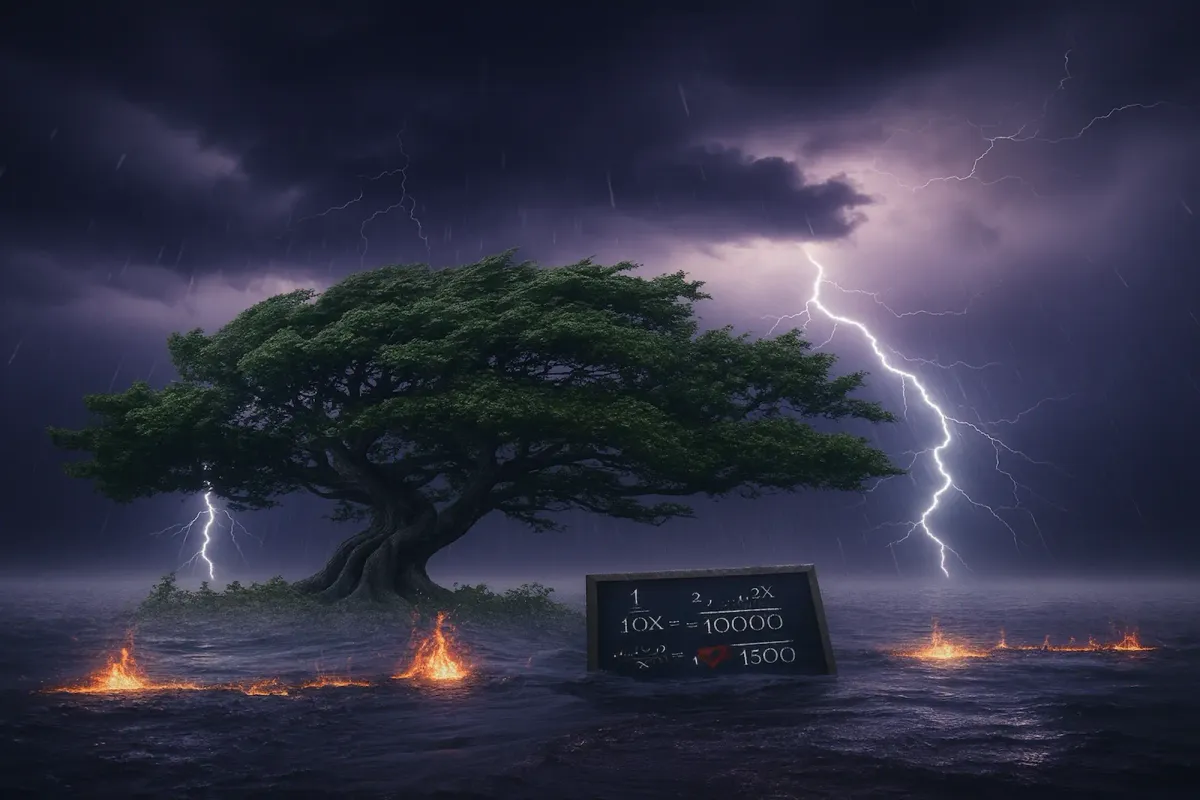
Rain is mathematically impossible.
And I’ll tell you why.
There are roughly 10⁴⁶ water molecules on Earth.[1] And a single raindrop contains around 10²¹ of them.[2] If you wanted to calculate the odds of those exact molecules combining to form a raindrop, you’d divide the number of favorable outcomes (one combination) by the number of possible combinations among all 10⁴⁶ molecules.
Put that into a probability formula and you get a number so small it makes the national debt look like pocket change. Something like:
1 in 10²⁵⁰⁰
There it is.
According to the logic we’re about to dismantle:
Rain is mathematically impossible.
It should never happen.
The universe cannot spontaneously assemble raindrops.
Therefore — by the astronomical-probability argument — rain must be a miracle.
A supernatural plumbing system. A divine sprinkler.
Except it rains constantly.
So what’s the problem?
Not the rain.
The calculation.
That probability figure only looks impossible because the denominator — the space of “all possible combinations” — is completely fake. The system isn’t selecting from all theoretical molecular permutations. Physics funnels water molecules into raindrops through evaporation, condensation, nucleation, pressure, temperature, and gravity. Nature channels outcomes; it doesn’t roll dice over raw chaos.
The probability of that combination is absurdly small.
The probability of rain is essentially 100%.
And that brings us to the real point.
The Same Trick Behind the “Astronomical Odds” Argument
This raindrop stunt is exactly what happens every time someone tries to “prove” intelligent design or special creation by slapping massive numbers on the table. They take real scientific calculations that were made for highly specific theoretical contexts and then pretend those numbers represent the probability of life, the universe, consciousness, evolution, or abiogenesis.
One of the favorites is Roger Penrose’s 1 in 10¹⁰¹²³ figure. It gets waved around by design advocates as if Penrose had calculated the odds of the universe existing by chance and declared it impossible.
But that’s not what Penrose did.
Penrose calculated a phase-space volume measure describing the entropy conditions of the early universe — a way to compare theoretical cosmological configurations, not a literal probability of existence or life.[3]
Using Penrose’s number as evidence for divine engineering is like using the price of a gallon of milk as proof of alien spacecraft landing schedules.
It’s context theft, and it’s dishonest.
Probability Means Nothing Unless the Denominator Is Real
Probability is simple:
P(event) = favorable outcomes / possible outcomes
If you inflate the denominator by counting outcomes that physics never allows, you can prove anything is impossible. Rain. Trees. Planets. Human speech. Dropping a pencil. Anything.
As physicist Sean Carroll points out, assigning probabilities without first defining the structure of the underlying possibility space is meaningless — if you don’t know what the denominator is, you aren’t calculating anything.[4] You’re just hallucinating with numbers.
But the design argument depends on exactly that error. It assumes:
all theoretical states are equally likely
there are no physical constraints
mechanism does not exist
everything is random chaos
That’s cartoon physics, not real physics.
Maybe the Probability Was Never Small
Here’s the part probability-wielding apologists never consider:
What if life wasn’t a lucky accident?
What if it was physically inevitable?
What if the laws of nature funnel matter toward complexity the way clouds funnel vapor into rain? What if there are countless chemical routes to life, countless molecular architectures that can become living systems?
If that’s true, then the probability of life in a universe like ours is not
1 in 10³⁰⁰⁰,
it’s 1 in 1.
Life might not be a miracle.
It might be what happens when chemistry is given time.
Bottom Line
If your entire argument depends on:
stealing giant numbers from scientific papers,
ignoring what they actually measure,
pretending chaos rules where laws do,
and packing the denominator with fantasy outcomes,
you’re not proving design.
You’re proving you don’t understand probability.
Rain isn’t a miracle.
It’s physics.
Life might be too.

If you find this work valuable and want to support future research and writing, including research and web-hosting costs, you can do so on patreon.
Works Cited
Carroll, Sean. The Big Picture: On the Origins of Life, Meaning, and the Universe Itself. Dutton, 2016.
Penrose, Roger. The Road to Reality: A Complete Guide to the Laws of the Universe. Alfred A. Knopf, 2005.
Penrose, Roger. Cycles of Time: An Extraordinary New View of the Universe. Alfred A. Knopf, 2011.
Rees, Martin. Just Six Numbers: The Deep Forces That Shape the Universe. Basic Books, 2000.
Estimated based on total mass of Earth’s water and Avogadro’s constant. ↩︎
Standard droplet composition estimates from physical chemistry measurements. ↩︎
Penrose describes the number as a phase-space volume comparison illustrating the extreme specialness of the initial low-entropy state, not a literal probability of existence. ↩︎
Carroll critiques probability assignments without defined state spaces in discussions of the Past Hypothesis and cosmology. ↩︎