
How Archaic English Becomes Evangelical Authority
Why do evangelicals suddenly speak in King James English when they pray or testify? This feature investigates sacred register-switching as performance — how archaic biblical language is used to project authority, silence dissent, and transform personal claims into prophetic command.
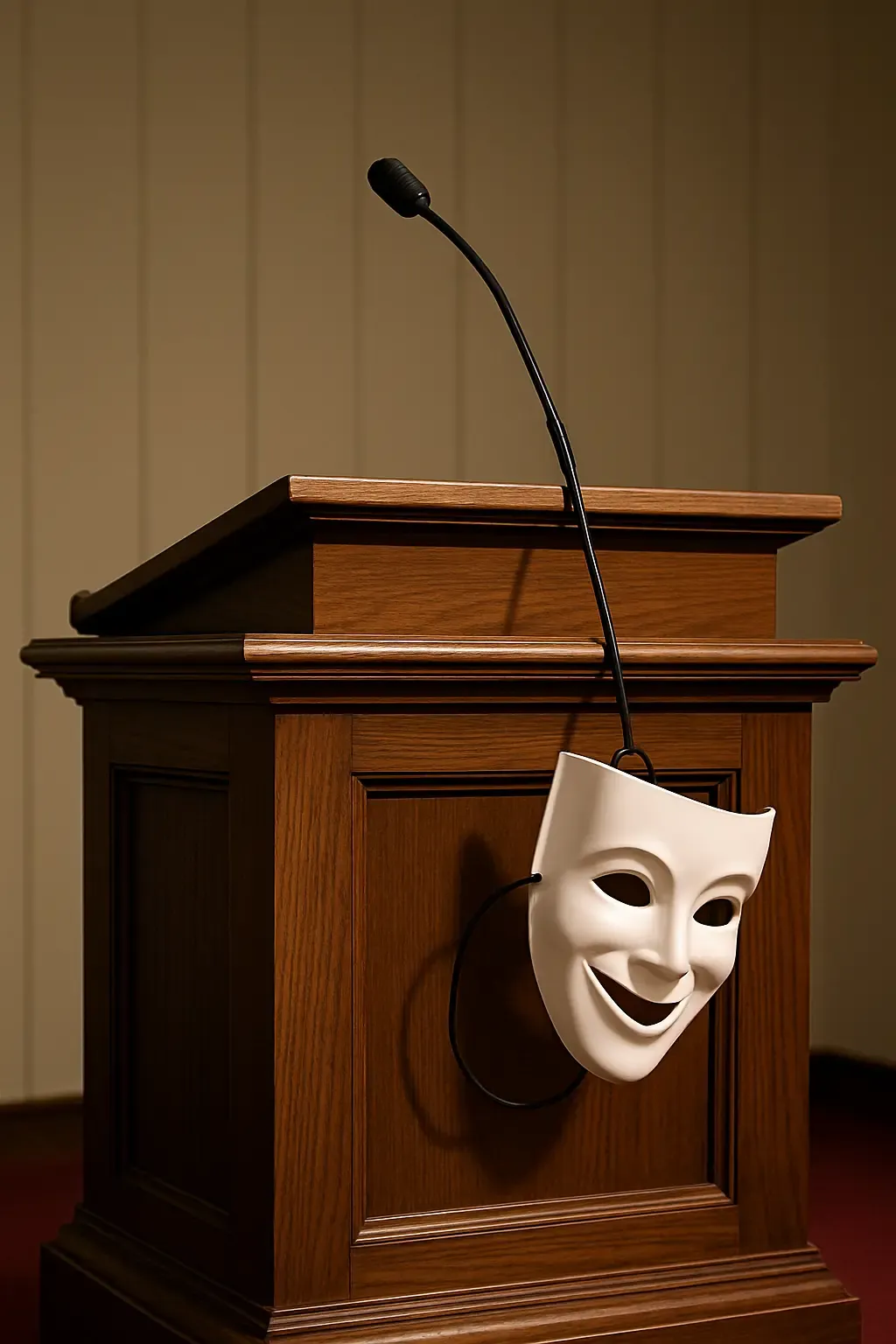
A strange performance unfolds every week in evangelical churches across America. Ordinary people who speak everyday, contemporary English suddenly shift into the archaic cadences of the King James Bible when they pray or testify. The transformation is dramatic: a linguistic costume that turns personal opinion into prophetic command. This article examines not the truth of religious belief, but the social and linguistic mechanics behind that sacred performance — how language itself becomes a tool of authority.
SEO excerpt
Why do evangelicals switch into Shakespearean English when speaking about God? This reported feature explores the phenomenon of sacred register as performance — how archaic biblical language grants speakers borrowed authority, silences dissent, and transforms ordinary speech into prophetic power.
It happens fast. Faster than most people notice.
One moment, a woman in a Midwestern evangelical church is speaking casually with the person beside her — modern English, relaxed posture, the familiar ease of everyday talk. And then she stands. Something shifts. Her shoulders square. Her breath deepens. Her voice slows as if stepping onto a stage.
“Brethren, the Lord hath laid this word upon my heart…”
The air in the room tightens. The congregation leans in. Heads bow. The transformation lands like a sudden drop in barometric pressure — something is happening here, something serious. What follows will not sound like regular speech, or even regular religious talk. It will sound older, heavier, deliberately ceremonial. It will sound like the King James Bible.
What it really is: performance.
Not performance as in fakery. But performance in the literal sociological sense — a ritual enactment of authority through language. A costume change, executed with nothing but sound.
It’s a move straight out of social dramaturgy, whether the speaker knows it or not.
The sociologist Erving Goffman, whose work still anchors modern communication studies, famously wrote that “the self … is a product of the dramatic interaction between performer and audience.” (Goffman 252). The church testimony moment is a perfect demonstration. A person steps into a role. The audience, trained through years of repetition, responds as an audience: reverently, silently, receptively. A closed circuit forms. Identity is not stated — it is performed into existence.
And that is the power of what some sociolinguists call a religiolect — a speech variety specifically tied to religious identity and practice.
This isn’t just prayer.
It’s staging.
For a deeper linguistic breakdown of how this sacred register functions, see the companion article:
The Prophet Complex — Why Evangelicals Use Archaic Bible Language
The Sacred Costume Change
Listen closely to the shift and the texture becomes unmistakable. The vocabulary tilts sharply toward the archaic: thee, thou, thy, thine, brethren, lest, iniquity, righteousness, perished. Verbs and syntax reshape themselves into biblical cadence: be not deceived, take heed, thus saith the Lord. The pacing changes. Pauses stretch for effect.
This isn’t simply “formal language.” It’s a curated style — lifted from a 17th-century register and preserved like an artifact in amber.
Linguists call this register switching: choosing a different style depending on the social circumstances. The linguist Douglas Biber defines a register as “a variety of language associated with a particular situation of use” (Biber and Finegan 3). Most register switching is subtle — how you speak to your boss versus your friends, or how a physician speaks to a patient versus another physician. That’s normal.
But the evangelical shift is not subtle. It’s abrupt, theatrical, unmistakably stylized. It is a move that says: This moment is not ordinary. Listen. Attend. Obey.
The term religiolect, used in sociolinguistic analysis, refers to speech varieties inside religious communities that function as identity markers and authority signals. The linguist Cristina Godoy-Schwab, whose research focuses on American Christian discourse, describes religious register as a “specialized linguistic code that marks communal identity and spiritual authority within Christian contexts” (Godoy-Schwab 7). In other words: speaking this way is not just expression — it is membership.
Say “God told me” in ordinary English and it sounds like opinion.
Say “The Lord hath spoken” and it carries the weight of revelation.
Same claim. Different costume.
Why the Voice Sounds 400 Years Old
There’s a reason this register feels frozen in time. Religious language doesn’t evolve like ordinary language. It hardens. It calcifies.
The historical linguist Christian Mair notes that sacred language tends to preserve archaic forms long after they disappear from everyday usage because communities perceive them as markers of tradition and authority (Mair 88). The King James Bible — published in 1611 — was the dominant English Bible for centuries, shaping weddings, funerals, hymns, revival meetings, and Sunday preaching. The emotional vocabulary of faith was stamped with its cadence.
Over generations, a powerful association formed:
Old = holy
Holy = authoritative
Once that association took root, modern phrasing could never compete. Contemporary English feels too thin, too ordinary, too familiar. It lacks ceremonial gravity. And ceremonial gravity is the currency of religious performance.
The linguist Rosina Lippi-Green puts it starkly: “Language is never neutral. Speakers use it to negotiate identity, power, and belonging.” (Lippi-Green 64). The archaic register is not simply a habit. It is a strategy — a public signal of sacred identity and a shortcut to credibility.
No theological degree? No seminary training? No evidence?
No problem — speak in the tongue of prophets, and authority arrives by sound alone.
Borrowed Authority
Nowhere is the performance more visible than in the moment when opinion becomes proclamation. When someone stands and declares, “I feel like God might be saying…” their claim is vulnerable to disagreement. They might be wrong. They might be questioned.
But when they declare, “Thus saith the Lord”, the rhetorical rules change. Disagreement becomes dangerous. Silence becomes expected. Inquiry becomes rebellion.
The linguist Deborah Cameron, professor at Oxford, writes that specialized rhetorical styles are often deployed not just to suit the context but to “project authority and claim legitimacy in domains where expertise is otherwise uncertain or contested.” (Cameron 112). What she describes is exactly what happens inside evangelical prophetic performance culture. People who possess no formal theological or scholarly credentials adopt the language of revelation as a proxy for authority itself.
The register becomes the credential.
And — crucially — the audience participates in the performance. They recognize the costume. They respond accordingly. They supply the reverence necessary to complete the illusion.
This is power by acoustics.
The content doesn’t need to be strong if the delivery signals certainty. A hollow idea dressed in prophetic cadence can sound unassailable. A weak argument spoken in sacred register can sound like divine command. And when that happens long enough, doubt becomes unthinkable.
What’s At Stake
This article is not about whether Christianity is true, or whether spiritual experience is genuine. The sincerity or accuracy of belief is not under evaluation. People believe for many reasons — personal, cultural, emotional, or existential — and those reasons deserve to be understood as very human, even if not respected by all.
But linguistic performance is a different matter. That can be examined without trespassing on faith.
The anthropologist Victor Turner, whose analysis of ritual remains foundational, wrote that ritual performance creates communitas — an emotional unity in which ordinary rational boundaries dissolve (Turner 127–129). In that environment, language does more than communicate. It binds. It guides perception. It shapes reality inside a shared frame.
And when a community learns that questioning the prophet voice is equivalent to questioning God, dissent becomes socially impossible. The register enforces unity. It polices doubt. It shields fragile claims from scrutiny.
That is the cost of sacred performance: when the costume becomes more powerful than the content, truth becomes secondary to theatrical success.
Remove the archaic register — strip the biblical cadence, the antique diction, the ritual pauses — and many proclamations collapse into ordinary claims. A great deal of religious certainty evaporates if forced to speak plainly.
If it takes a costume to make an idea feel true,
how true was it to begin with?
Works Cited (MLA)
Biber, Douglas, and Edward Finegan. Sociolinguistic Perspectives on Register. Oxford UP, 1994.
Cameron, Deborah. Verbal Hygiene. Routledge, 1995.
Goffman, Erving. The Presentation of Self in Everyday Life. Anchor Books, 1959.
Godoy-Schwab, Cristina. Stylistic Variation Within the Religious Register. Emory University Dissertation, 2019.
Lippi-Green, Rosina. English with an Accent: Language, Ideology, and Discrimination in the United States. Routledge, 2012.
Mair, Christian. Twentieth-Century English: History, Variation and Standardization. Cambridge UP, 2006.
Turner, Victor. The Ritual Process: Structure and Anti-Structure. Aldine, 1969.