
The Case Against Mother Teresa: Medical Neglect, Suffering, and the Myth of Sainthood
A documented examination of Mother Teresa’s legacy, from medical neglect and sanctified suffering to financial opacity, political moral laundering, and a canonization process that ratified myth over evidence.
Key Takeaways: The Case Against Mother Teresa
- Medical Neglect: Evidence from medical journals like The Lancet¹ suggests a systemic lack of diagnostics and pain management in her missions.
- Theology of Pain: Her documented belief that suffering was a *“gift from God”*² often took precedence over professional medical care.
- Financial Opacity: Despite raising hundreds of millions³, the organization lacked transparency regarding how much was actually spent on patient care.
- Political Laundering: She frequently lent moral legitimacy to abusive regimes, such as the Duvalier dictatorship⁴ in Haiti.
Table of Contents
- Introduction: When Charity Refuses to Heal
- Charge I: Medical Neglect as Doctrine, Not Accident
- Charge II: The Theology That Made Neglect Virtuous
- Charge III: Austerity as Moral Theater
- Charge IV: Moral Laundering: Money, Dictators, and Silence
- Charge V: Absence and the Maintenance of Myth
- Charge VI: Canonization Without Scrutiny
- Verdict: A Reputation That Did the Work
- Works Cited
Introduction: When Charity Refuses to Heal
Mother Teresa is remembered as a figure inseparable from compassion—an emblem of mercy standing beside the poorest of the poor. Her image is that of a woman kneeling at the bedside, whispering comfort to the dying, embodying selfless devotion.
That image collapses under examination.
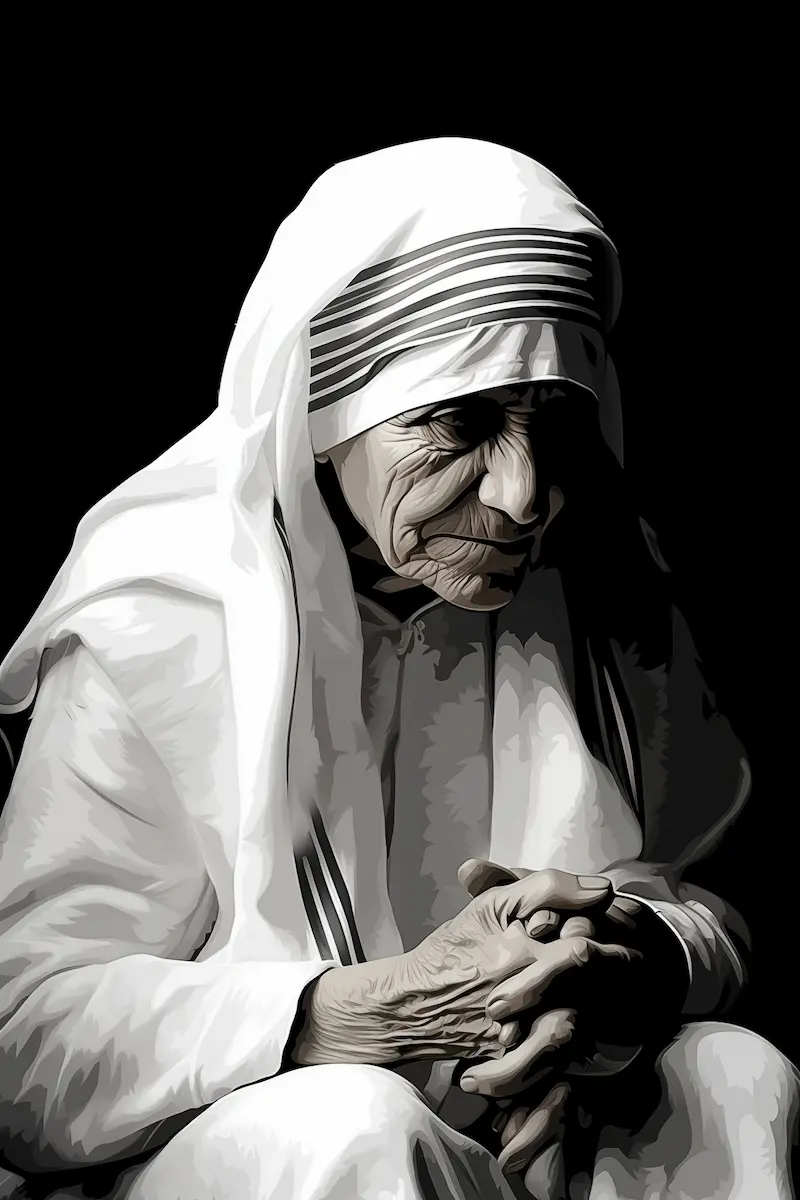
What her institutions consistently offered was not medical care in any meaningful sense. It was custodial suffering. People were taken in, housed, fed minimally, prayed over, and left to endure illness largely untreated. They were rarely diagnosed. Their conditions were seldom explained. Medical records, where they existed at all, were skeletal. Pain relief, when administered, almost never extended beyond aspirin or similar over-the-counter analgesics.
This was not due to a lack of resources. It was a choice.
The central question is not whether Mother Teresa was personally kind or sincere. The question is whether sincerity excuses a system that transformed preventable pain into spiritual theater.
Charge I: Medical Neglect as Doctrine, Not Accident
Visitors and volunteers repeatedly described the same conditions across decades and continents. Patients lay on hard cots in overcrowded rooms. Cleanliness was inconsistent. Professional medical staff were scarce. Diagnosis was minimal to nonexistent.
Most striking was pain management—or rather, the absence of it.
Dr. Robin Fox, editor of The Lancet, reported that patients suffering from terminal cancer, advanced infections, and severe injuries were routinely given little more than basic over-the-counter analgesics. No morphine. No opioids. No modern palliative protocols. No systematic attempt to control agony at the end of life.¹
This was not because such medications were unavailable. Hospitals in Calcutta used them routinely. Nor was it because the Missionaries of Charity lacked funds. They did not lack money. They lacked theological permission.
Journalist Mary Loudon recounts speaking with an American physician volunteering at one of the homes. He described patients enduring extreme, unnecessary pain that could have been easily controlled with standard medical care. When he asked why stronger pain relief was not used, the answer was not logistical. It was philosophical.
Suffering was meant to be endured.
Loudon records the case of a fifteen-year-old boy with a kidney condition that was entirely treatable with antibiotics and surgery. He received neither. The doctor insisted the boy be transferred to a hospital. The request was denied.
The explanation was explicit: if they did it for one, they would have to do it for everybody.²
This was not triage under scarcity.
It was institutional policy.
Charge II: The Theology That Made Neglect Virtuous
Mother Teresa did not obscure her views on suffering. She articulated them openly and repeatedly.
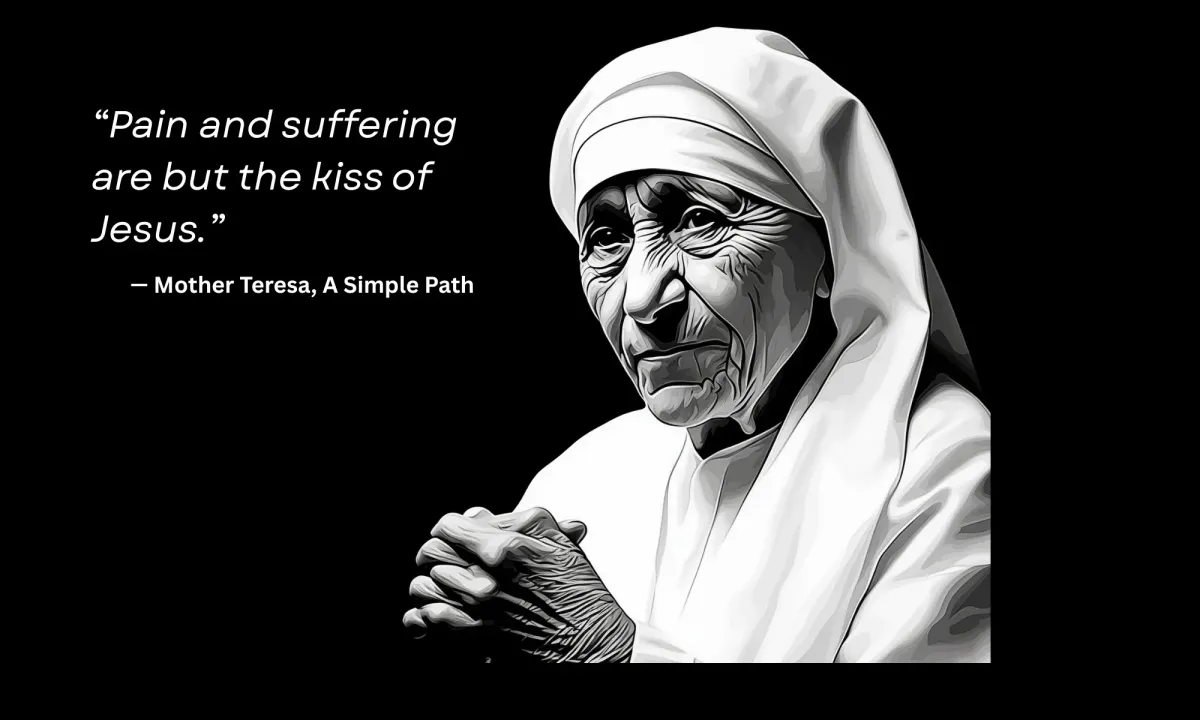
In A Simple Path, she described pain as *“the kiss of Jesus.”*² This was not metaphorical comfort. It was a theological framework that reclassified physical agony as spiritual privilege.
At a 1981 press conference reported by The Washington Post, she stated that it was “very beautiful for the poor to accept their lot,” and suggested that the world itself was spiritually enriched by their suffering.³
Christopher Hitchens records her questioning whether the poor might suffer because they want to suffer, and whether relieving that suffering risked depriving them of spiritual grace.⁴
Once this theology is understood, the operational logic of her institutions becomes clear. Diagnosis becomes secondary. Treatment becomes optional. Pain relief becomes morally suspect.
Suffering was not an unfortunate byproduct.
It was the point.
Charge III: Austerity as Moral Theater
Mother Teresa’s image of radical simplicity—bare rooms, hard beds, minimal supplies—was presented as humility and solidarity with the poor.
In reality, the Missionaries of Charity accumulated vast wealth. According to Hitchens, donations from governments, corporations, and private benefactors amounted to tens or hundreds of millions of dollars over decades.⁴
There was no parallel investment in hospitals, trained medical staff, or modern palliative care. Financial transparency was effectively nonexistent. The austerity was not imposed by poverty.
It was curated.
Austerity functioned as spectacle, converting deprivation into moral symbolism while insulating the organization from accountability.
Charge IV: Moral Laundering: Money, Dictators, and Silence
Mother Teresa’s moral authority proved extraordinarily useful to people and regimes in need of reputational cleansing.
She accepted large donations from Charles Keating, later convicted for his role in one of the largest financial frauds in American history. When Keating was prosecuted, Hitchens records that Mother Teresa wrote directly to the sentencing judge requesting leniency—without acknowledging the harm inflicted on thousands of victims.⁴
Crucially, prosecutors in the case formally requested that Mother Teresa return the money Keating had donated so it could be used to compensate those victims. The letter was ignored. The funds were never repaid.
Her political alliances followed the same pattern.
She publicly praised Jean-Claude “Baby Doc” Duvalier and his wife while accepting donations from their regime, which was responsible for mass killings, torture, and systemic theft in Haiti.⁵ She offered no public condemnation of those crimes.
She also expressed admiration for Albania under Enver Hoxha, one of Europe’s most repressive dictators, whose regime oversaw executions, labor camps, and brutal political repression. Her praise was offered without acknowledgment of those realities.
In each case, her presence conferred legitimacy.
Her silence implied absolution.
This was not neutrality.
It was moral laundering.
Charge V: Absence and the Maintenance of Myth
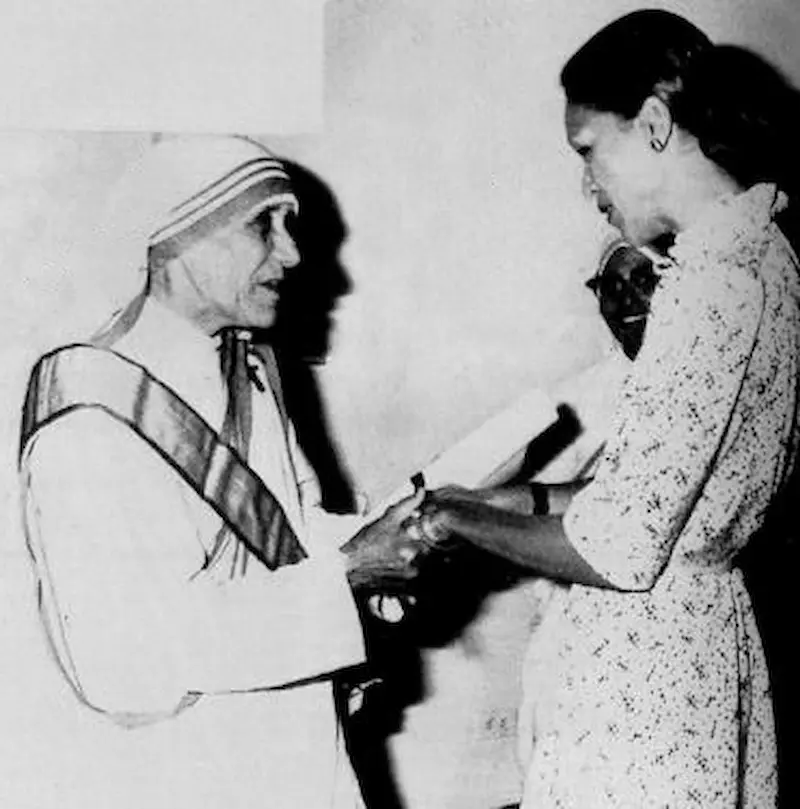
As Mother Teresa’s fame expanded, her physical presence among the poor diminished. From the late 1970s onward, she spent much of her time traveling internationally—attending award ceremonies, fundraising events, and meetings with political leaders.
Hitchens noted that during the period when she was most associated with bedside devotion, she was often not in India at all.⁴
The Missionaries of Charity operated under strict centralized authority, yet oversight increasingly became symbolic. Young, minimally trained sisters were left to manage expanding institutions while the public image of constant presence remained intact.
The myth persisted because it was useful.
Charge VI: Canonization Without Scrutiny
Canonization did not resolve the contradictions surrounding Mother Teresa. It sealed them.
The mandatory five-year waiting period was waived. The process was accelerated. Miracle claims were disputed by treating physicians and certified regardless. Medical dissent was acknowledged and overridden.
Canonization did not investigate the record.
It finalized a narrative.
Verdict: A Reputation That Did the Work
Hitchens quoted Mark Twain: give a man a reputation as an early riser, and he can sleep until noon.
Mother Teresa’s reputation did extraordinary work. It transformed neglect into humility, pain into virtue, and secrecy into sanctity. It shielded an institution that consistently failed to meet even minimal standards of medical care.
History is not bound by sainthood.
It is bound by evidence.
And the evidence shows that suffering was not relieved.
It was sanctified.
Works Cited
Fox, Robin. “Mother Teresa’s Care for the Dying.” The Lancet, vol. 316, no. 8207, 1980, pp. 145–46.
Hitchens, Christopher. The Missionary Position: Mother Teresa in Theory and Practice. Verso, 1995.
Kohl, Allan. “Haiti Under the Duvaliers.” Journal of Caribbean Studies, vol. 9, no. 2, 1987, pp. 45–68.
Loudon, Mary. “The Poor Are Still with Us.” The Observer, 25 Oct. 1981.
Mother Teresa. A Simple Path. Ballantine Books, 1995.
“The Washington Post.” “Mother Teresa Defends Her Austerity.” 1981.