
Testing Creationism Against the Evidence We Actually Observe
Table of Contents
- One Reality, Two Explanations
- Observation 1: Extreme Diversity Within Related Animals
- Observation 2: Fossils Show Gradual Change
- Observation 3: Life Forms Nested Family Trees
- Observation 4: Vestigial Structures Persist
- Observation 5: Shared Broken Genetic Instructions
- Observation 6: Shared Ancient Viral Insertions (ERVs)
- Observation 7: Life Does Not Radiate From a Single Point
- Observation 8: Reproductive Boundaries Are Gradual
- Conclusion
One Reality, Two Explanations
There is only one natural world. Fossils lie where they lie. Animals live where they live. Bodies are built the way they are built. None of this changes depending on what someone believes about origins. What changes is how those facts are explained.
In debates about creationism and evolution, the disagreement is rarely about the evidence itself. It is about how explanations are constructed. One approach begins with a conclusion and then adjusts the explanation whenever the evidence becomes inconvenient. The other begins with the evidence and tests whether its ideas survive contact with reality.
A useful rule of thumb is this: a theory that explains everything after the fact predicts nothing beforehand. Or, put another way, if the map is redrawn every time the terrain disagrees, the problem isn’t the terrain. As we will see repeatedly, evolution leaves fingerprints; creationism keeps changing gloves.
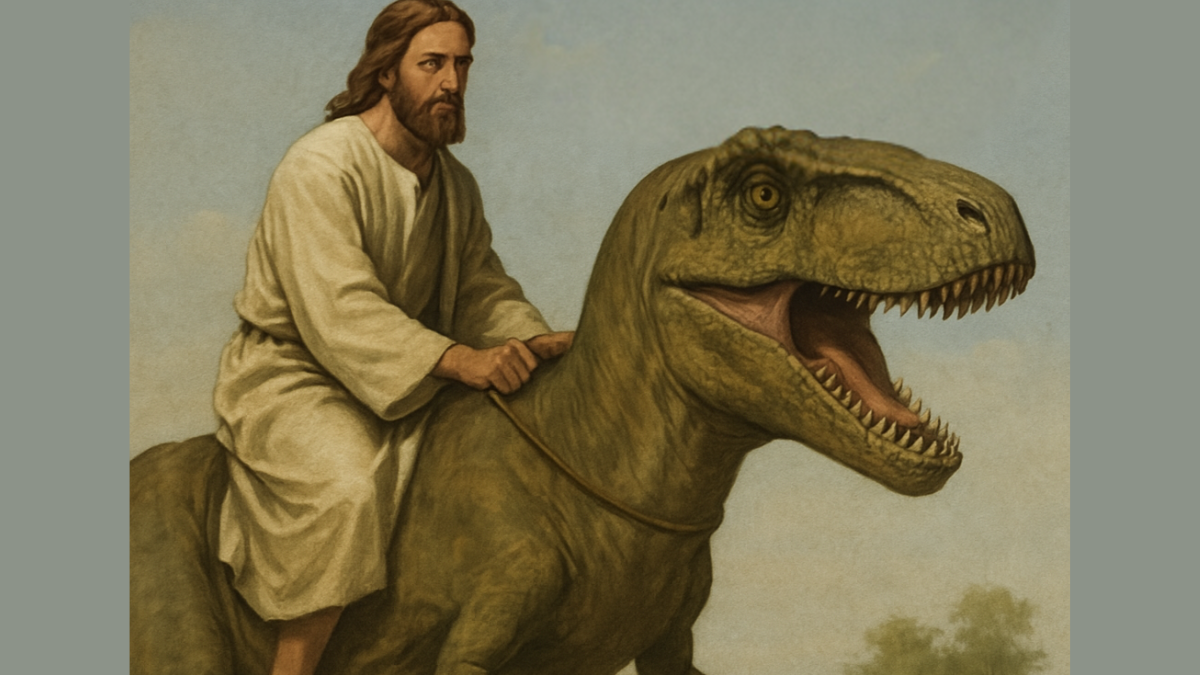
Such imagery implies human–dinosaur coexistence despite overwhelming fossil, genetic, and geological evidence to the contrary.
Observation 1: Extreme Diversity Within Related Animals
Closely related animals can differ dramatically in size, shape, diet, and behavior. Bears include massive polar hunters, forest omnivores, and pandas that eat almost nothing but bamboo. Dogs range from wolves and coyotes to foxes and tiny domestic breeds. Similar diversity appears in cats, turtles, snakes, and many other groups.
In bears alone, there are five living genera and eight living species, along with many extinct species known from fossils.
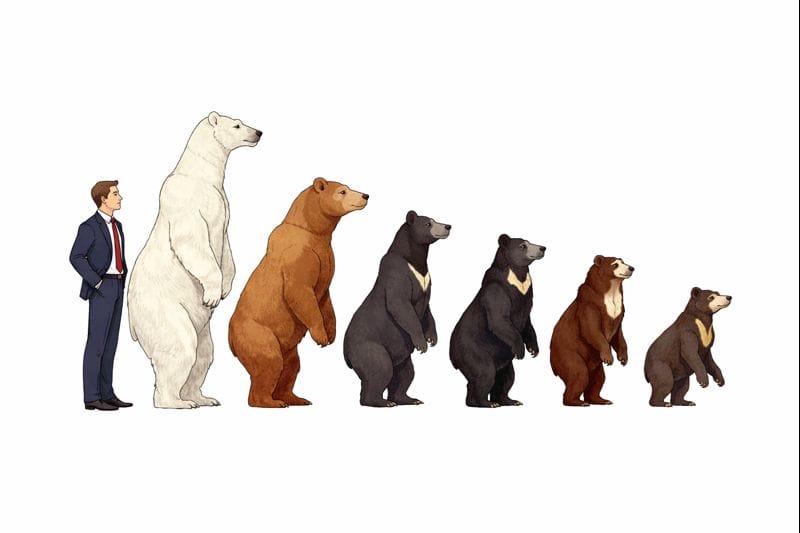
Modern bears span multiple genera and ecological niches, illustrating the scale of diversification that must be explained.
How Creationism Explains This
Under Young Earth Creationism, each major group descends from a single ancestral pair preserved on Noah’s Ark. After the Flood, that pair rapidly diversified into all modern forms.
To make this work, change must occur orders of magnitude faster than evolutionary theory proposes. This requires the formation of multiple species and genera within just a few thousand years—far more rapid change than evolution ever claims.
What counts as an acceptable boundary is defined only after the full diversity is known. When diversity is inconveniently large, the boundaries are adjusted. This is both
ad hoc
and post hoc:
the explanation exists to protect the conclusion rather than to follow the evidence.
How Evolution Explains This
Evolution explains diversity as gradual change over long periods of time. Populations spread into new environments, differences accumulate, and those differences affect survival and reproduction.
The amount of change observed fits comfortably within processes that can be measured and observed today.
Observation 2: Fossils Show Gradual Change
Fossils do not show animals appearing suddenly in their current forms. Instead, they reveal long sequences of organisms that gradually change over time, with features shifting shape and function across layers of rock.
How Creationism Explains This
Creationism holds that major groups were created separately and should remain distinct. Fossils that blur those distinctions are therefore a problem.
The usual response is to redraw boundaries after such fossils are found. A fossil that looks like a mix of two groups is reclassified as belonging fully to one of them. This boundary-shifting is again
ad hoc
and
post hoc
.
Because the boundaries are never defined beforehand, there is no way to predict what fossils should or should not exist. The creationist hypothesis has no predictive power here.
How Evolution Explains This
Evolution expects gradual change. If one group gives rise to another, intermediate forms should exist.
That is exactly what the fossil record shows, and those fossils appear in a consistent order.
Observation 3: Life Forms Nested Family Trees
When organisms are grouped by anatomy, fossils, development, or genetic traits, the same pattern appears repeatedly: branching family trees.
How Creationism Explains This
Appeals to similar design do not explain why similarities always form clean branching patterns rather than mix-and-match designs.
Traits with no obvious functional role—minor skeletal details, embryological patterns, and shared genetic quirks—still fall into the same tree-like structure. The pattern is not predicted in advance; it is recognized only after it becomes unavoidable.
How Evolution Explains This
Evolution predicts branching patterns as populations split and diverge over time.
Independent lines of evidence converge on the same family trees.
Observation 4: Vestigial Structures Persist
Many organisms possess
vestigial structures—reduced or leftover body parts that resemble fully functional versions found in related species.
Observation 5: Shared Broken Genetic Instructions
Some genetic instructions no longer function properly. These
pseudogenes
resemble working versions in related species but contain disabling changes.
Observation 6: Shared Ancient Viral Insertions (ERVs)
Many species carry fragments of ancient viruses embedded in their DNA, known as
endogenous retroviruses (ERVs).
Conclusion
Both creationism and evolution attempt to explain the same world. The difference lies in how each responds to unexpected facts.
Young Earth Creationism encounters observations it did not predict and explains them away after the fact. Evolutionary theory relies on a small set of well-tested ideas applied consistently.
The facts do not change. What changes is how much an explanation must bend to accommodate them.
If you find this work valuable and want to support future research and writing, including research and web-hosting costs, you can do so on patreon.