Noah’s Ark and Wooden Ship Engineering: Why It Wouldn’t Float
An engineering and historical breakdown of why Noah’s Ark, as described in Genesis, would be physically impossible to build or survive the supposed global flood.
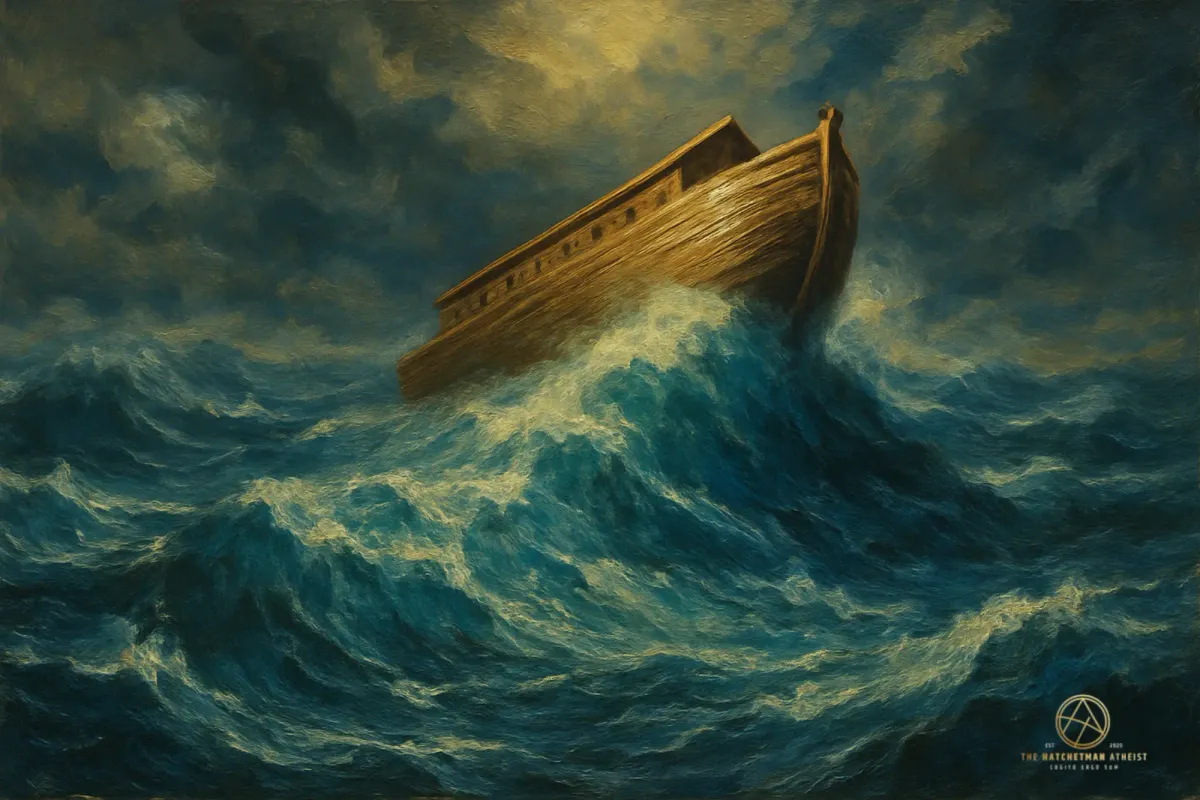
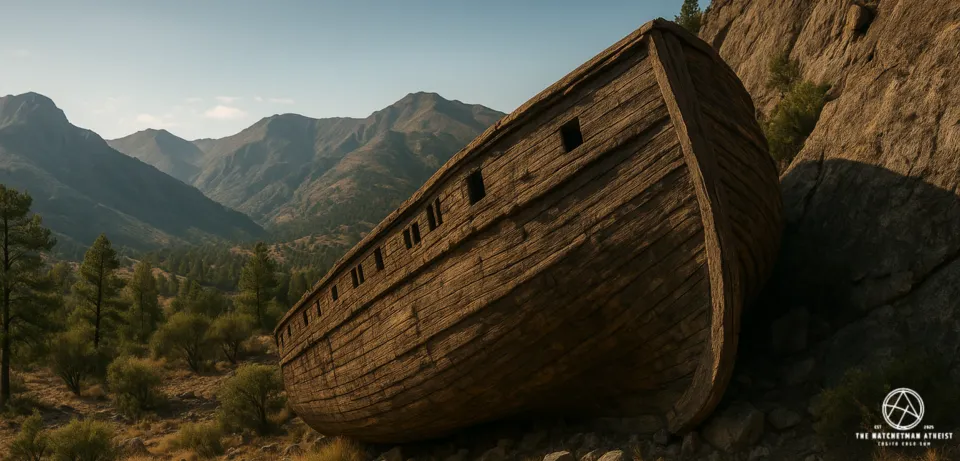
The Genesis flood story describes a massive wooden vessel built by Noah, allegedly surviving a world-engulfing rainstorm lasting forty days and nights. But how would a ship of that size — made entirely of wood — actually fare? When we look at the math, naval engineering, and history, the answer is simple: it wouldn’t.
How Much Rain Would It Take?
Genesis says the water rose high enough to cover “all the high mountains under the whole heaven” (Gen. 7:19). The tallest mountain on Earth is Mount Everest, which stands at 29,032 ft (8,849 m).
The Bible says this happened in 40 days. To flood the entire Earth above Everest in that time, rainfall would need to average about:
- Total height: ~29,000 ft of water
- Over 40 days = 960 hours
- 29,000 ÷ 960 ≈ 30 feet per hour
That’s the rate of rain needed: thirty vertical feet of water every single hour, without stopping, for 960 hours straight.

What Does 30 Feet Per Hour Mean?
For context:
- The heaviest rain ever recorded on Earth is about 12 inches in 42 minutes (Holt, Missouri, 1947).
- The Genesis rate? 360 inches per hour.
- That’s about 700 times more intense than the most extreme rainfall in history.
At that rate, you don’t have “rain” — you have Niagara Falls dropping from the sky.
The Ark’s Dimensions
Genesis 6:15 gives the measurements:
- Length = 300 cubits = ~450 ft
- Width = 50 cubits = ~75 ft
- Height = 30 cubits = ~45 ft
That makes a roof area of 33,750 square feet — about ¾ of an acre. Here “roof area” means the horizontal top deck and any roofing structure over it, not just the tiny cabin with a window often shown in children’s drawings. We’re talking about the entire exposed top surface of the ark.
The Drainage Problem
Here’s where the math bites back:
- Rain volume per hour = Roof area × Rain depth
- = 33,750 sq ft × 30 ft
- = 1,012,500 cubic ft of water/hour
That equals about 7.6 million gallons of water slamming onto the ark every single hour. For comparison, that’s about the volume of 12 Olympic swimming pools every hour — but remember, this is hitting a single ship, not spread across a region.
Now ask yourself: how does a flat wooden roof get rid of 7.6 million gallons an hour?
- Wooden planking is not waterproof (even modern ships with tar and pitch leak).
- There are no pumps, scuppers, or engineered drainage systems described.
- Water would pool, the weight would increase, and the roof would collapse.
Even if it had perfect gutters, they would need to move water at a rate greater than the flow of a medium-sized river — just to keep the deck clear.
The Structural Integrity Problem
Even before rain enters the picture, there’s another issue: could a 450-foot wooden ship even exist?
- The longest known wooden ships in history were 19th-century lumber schooners like the Wyoming (329 ft).
- The Wyoming required massive iron bracing, leaked constantly, and still eventually sank.
- Ancient vessels (Greek triremes, Roman grain ships, Chinese junks) maxed out closer to 150–200 ft. Beyond that, wood simply bends and cracks under wave stress.
Wave stress explained: A ship rides waves that lift one section of the hull while dropping another. This causes the vessel to flex — called “hogging” when the bow and stern sag lower than the center, and “sagging” when the center dips lower than the ends. In a 450-foot wooden ship, the torque forces are enormous. The bending moment from a single large wave could apply millions of pounds of pressure across the hull. Wood, without steel reinforcement, cannot withstand such repeated torque. The longer the ship, the greater the twisting forces — and at 450 feet, the stresses would split the hull apart.
A 450-foot ark built entirely of wood, without iron reinforcement, would flex and split open in any serious sea. Naval historians universally agree this is a structural impossibility.
What about the gaps between the planks? As the wood became waterlogged, it would expand more than the allotted space in the seams, causing the hull to deform or break apart even faster.
Lessons from the USS Wyoming
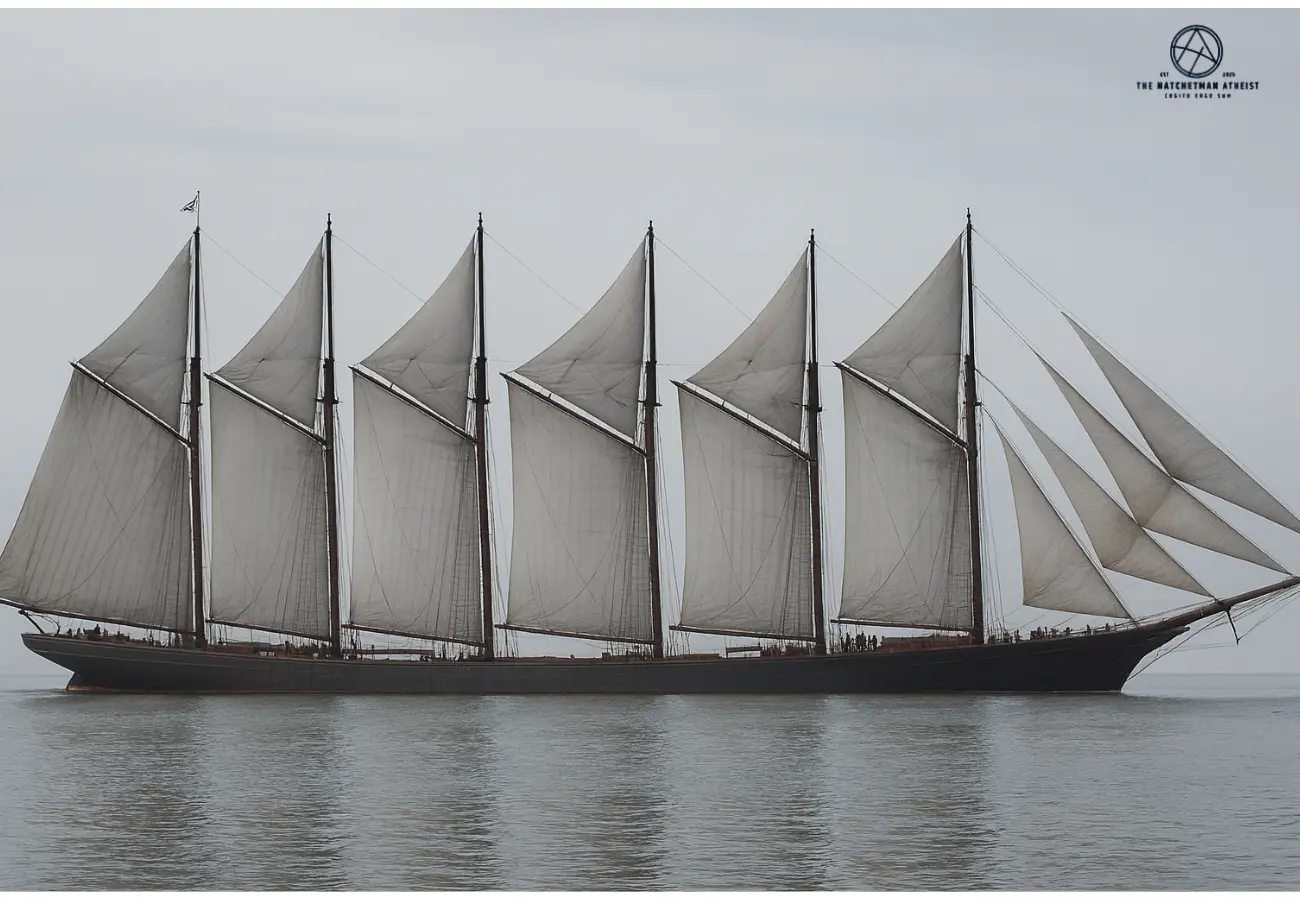
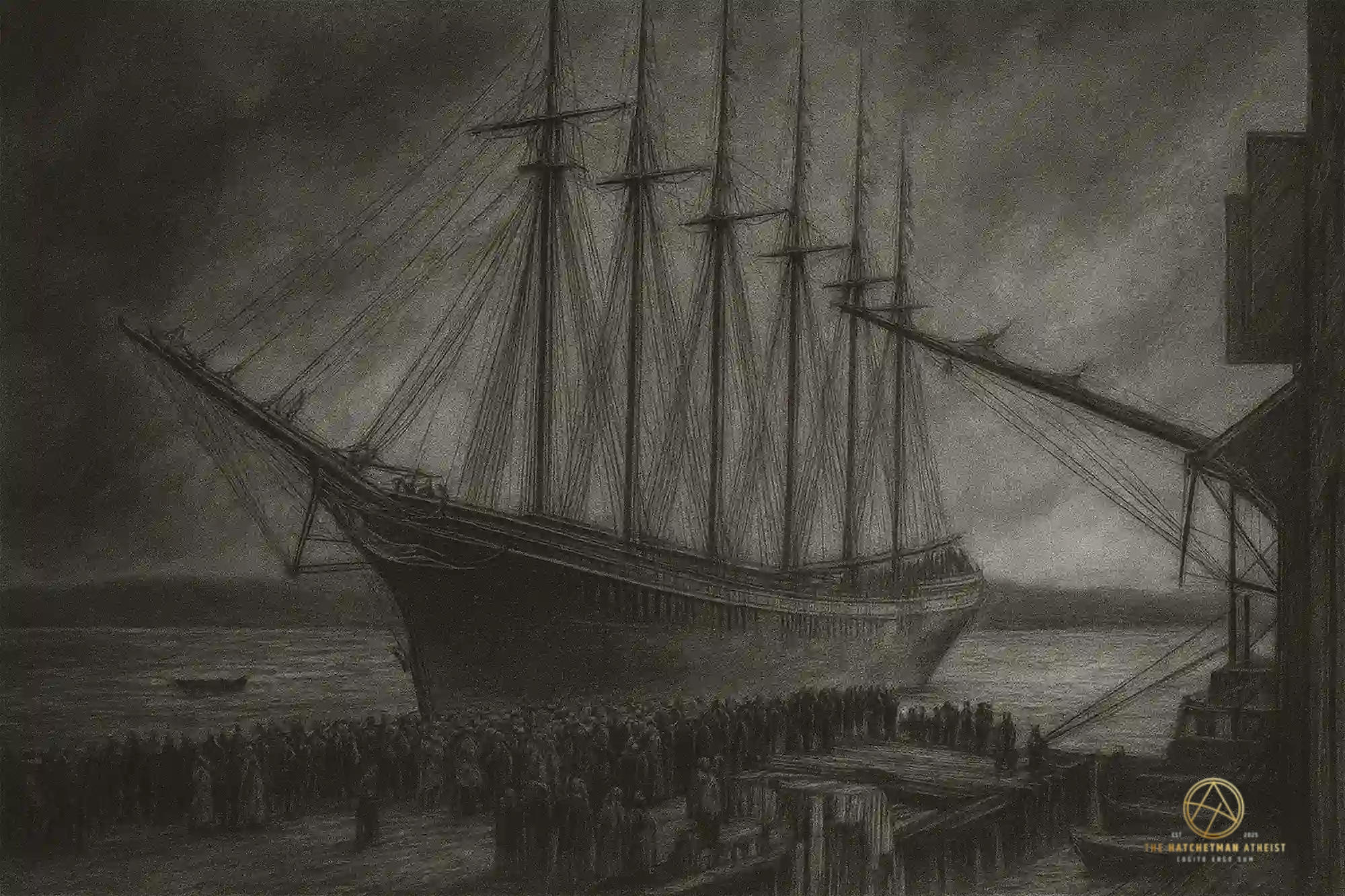
The schooner Wyoming, launched in 1909, was the longest wooden ship ever built at 329 feet. Despite its impressive size, it had constant structural issues. The hull flexed in heavy seas, opening seams between planks. This allowed water to flood in, requiring continuous pumping. To counteract these problems, the builders added massive iron cross-bracing and used steam pumps to keep the ship afloat. Even with these measures, the Wyoming leaked heavily whenever it encountered rough water.
Wooden ships of more ordinary size in the 19th century might last a decade or two with good maintenance. The Wyoming, by contrast, was plagued with problems throughout its short service life and lasted barely 15 years before sinking in 1924 with the loss of all 14 crew members. It went down in a gale off Massachusetts, overwhelmed by the same flexing, leaking, and waterlogging issues that plagued its entire career.
Compared to the Genesis ark, which was supposed to be even longer at 450 feet and constructed without the benefit of steel reinforcement or powered pumps, the problems would be magnified. If the Wyoming, with all of its advanced 20th‑century engineering aids, could not survive long, then a Bronze Age ark three times larger than the largest ancient ships would fare far worse. Instead of surviving forty days of catastrophic rain and rising seas, the ark would have failed in hours or days, exactly as the Wyoming ultimately did.
Why It Would Sink Almost Immediately
Put it together:
- Impossible Rainfall — 30 ft/hour means an impact load equivalent to 63 million pounds of water falling on the deck every hour.
- No Drainage — The ark would be buried in water pooling on the roof within minutes.
- Wooden Hull Limits — Ships of that size can’t survive stresses at sea; history shows us they broke apart or leaked fatally.
- Rising Seas — Even if it didn’t collapse right away, it would be swamped by wave action and water intrusion through seams. Once the waterline reached the open deck, inflow would exceed buoyancy almost instantly.
Estimate of sinking time: Let’s say even 10% of the hourly rainfall (about 760,000 gallons) pooled on deck for just 10 minutes. That’s ~100,000 gallons, or 834,000 pounds of extra load, pressing down on the roof structure. Within an hour, millions of gallons would overwhelm the vessel’s displacement capacity (about 43,000 tons at most by volume). In plain terms, the ark would likely sink within the first hour or two of such rainfall — long before forty days passed.
The Bottom Line
If the Genesis flood happened literally as described:
- Rainfall rates would be physically impossible.
- The ark’s design would fail both structurally and hydrodynamically.
- Wooden shipbuilding technology, ancient or modern, couldn’t achieve what the Bible demands.
The story works as myth, not as engineering.
Works Cited
Brown, David. Voices from the Sea: Shipwrecks of the Wooden Era. Naval Institute Press, 2001.
Haslach, Henry W. Failure of Large Wooden Ships. Journal of Materials in Civil Engineering, vol. 8, no. 1, 1996, pp. 8–12.
Scott, Richard. Seafaring in the Ancient World. University of California Press, 1995.
U.S. National Weather Service. “Record Rainfall Events.” NOAA, 2024.