Who Are We Really Meeting in Near-Death Experiences?
Why do some people meet living relatives during "near-death" experiences? Explore the data showing that NDEs often happen to people who aren't even dying and feature visions driven by emotion rather than the afterlife.

And Why So Many NDEs Happen When Death Isn’t Even Close
Table of Contents
- Introduction
- Part I: Seeing the Dead — Who Aren’t Actually Dead
- Part II: What If You’re Not Even Dying?
- What Does This Tell Us?
- Works Cited
Introduction
Many near-death experiences (NDEs) involve vivid encounters with deceased relatives or familiar figures. These scenes are often interpreted as evidence of life after death.
But the data tells a more complicated story.
The following cases from the academic literature illustrate a recurring but under-discussed feature of near-death experiences: the loved ones encountered on the “other side” are not always dead and sometimes are not even absent—a fact that complicates claims about their spiritual origin.
This article is one case study within a larger examination of near-death experiences. The series begins with a detailed explanation of what the brain is doing during NDEs:
Part I: Seeing the Dead — Who Aren’t Actually Dead
The Case of the Living Uncle
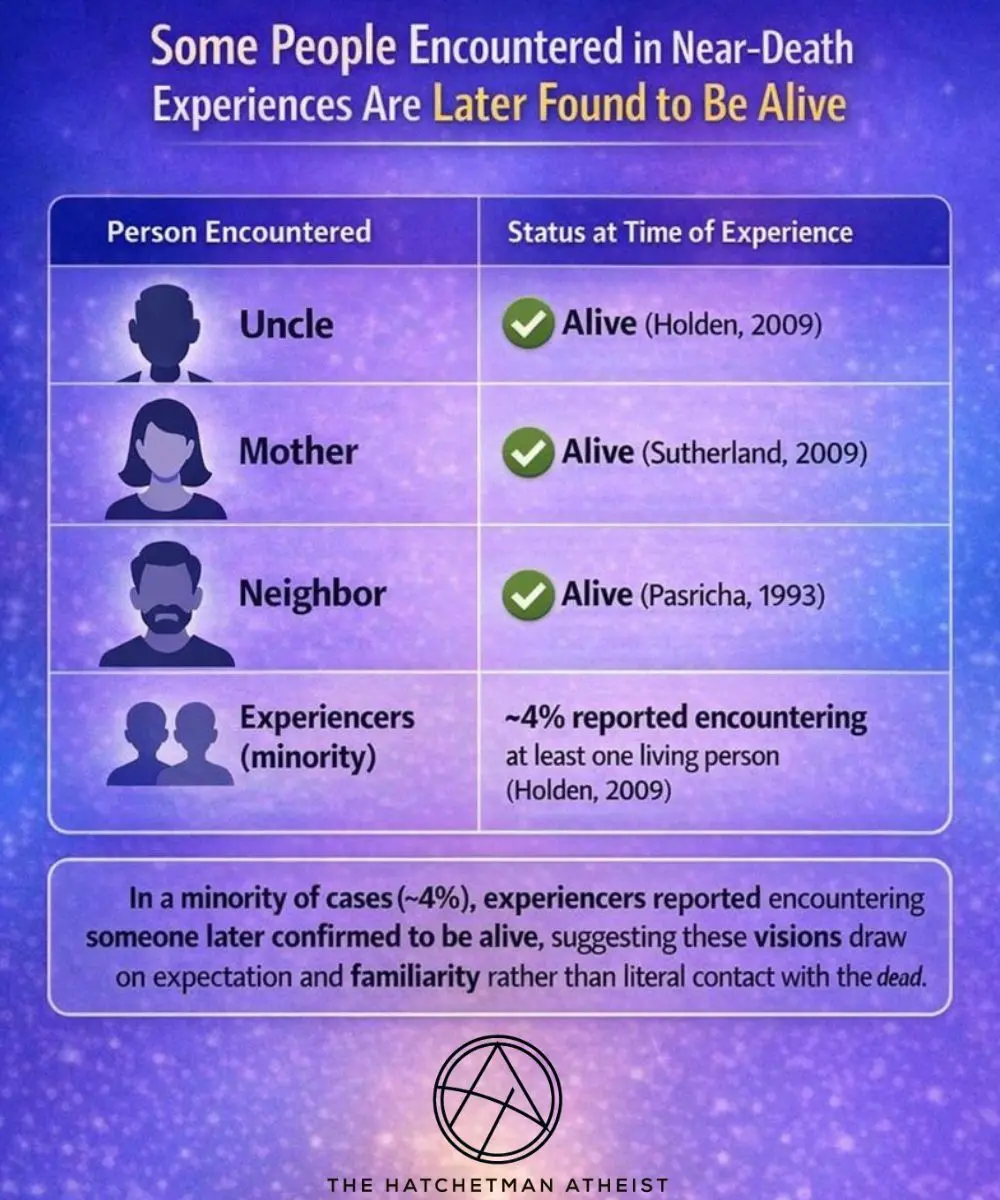
In one of the most cited anomalies, a woman reported seeing a group of people during her NDE—including her uncle, whom she assumed had died. When she recovered, she learned he was alive and well.
“She was surprised to see him because, to her knowledge, he was still alive. Upon her recovery, she learned that her uncle was indeed alive and well at the time of her crisis.”
— Holden (2009), p. 195
This case illustrates how the brain may misidentify familiar figures, drawing on emotionally salient templates rather than presenting objective information.
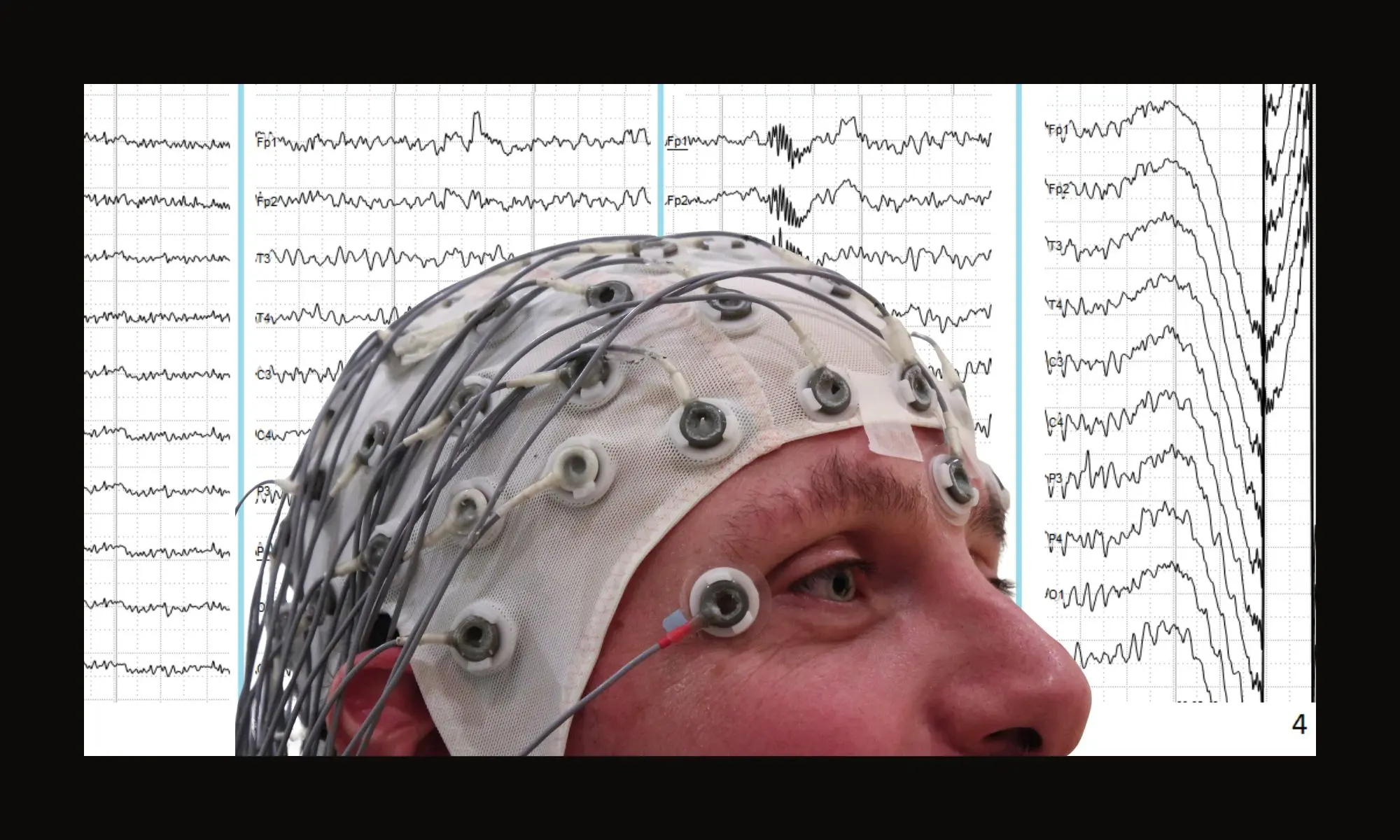
NDEs may be internal “projections” where the brain renders emotionally significant figures from memory during a crisis.
The Living Mother
Cherie Sutherland (2009) describes a case in which a child who experienced cardiac arrest reported seeing his mother “in the light.” Upon revival, he told her she had been there waiting for him—even though she had remained physically present at his hospital bedside.
The implication is clear: the child’s mind rendered the person he most needed to see, regardless of her actual location or status.
— Sutherland, in Holden (Ed.), 2009, Chapter 9
The Bureaucratic Afterlife — and a Living Neighbor
In a case from India, an experiencer found himself in the Yamraj court, a bureaucratic afterlife realm from Hindu tradition. There, he saw a man from his village.
“He told the officials, ‘That man is my neighbor; why is he here?’ They told him that they had made a mistake and that he should go back. The neighbor... was found to be alive when the man recovered.”
— Pasricha, 1993, p. 167
Not a Fluke: The 4% Pattern
These aren’t one-off anomalies. In her analysis of hundreds of cases, Holden found that:
“In a minority of cases—about 4 percent in my own study—experiencers reported meeting persons who were still alive at the time of the NDE... These encounters suggest that meeting deceased persons... may be more related to the experiencer’s expectations or psychological needs than to the objective presence of deceased spirits.”
— Holden (2009), p. 195
These cases reveal something essential: NDEs don’t operate as literal visitations from the dead. Instead, they draw from the experiencer’s personal world—emotionally salient figures, memories, and assumptions—regardless of factual reality.
Part II: What If You’re Not Even Dying?
A second assumption is that NDEs only happen in the shadow of death—cardiac arrest, trauma, coma.
But that’s not what the research shows.
A 2014 study in Frontiers in Human Neuroscience found that, within this cohort, over a quarter of NDEs occurred in people who were not in life-threatening situations.
Out of 190 people who met standard NDE criteria:
- 140 had experiences during confirmed life-threatening events
- 50 (≈26.3%) had them during non-lethal episodes such as fainting, anesthesia, sleep paralysis, or intense emotional distress
“The intensity and content of the experience did not differ between ‘real NDE’ and ‘NDE-like’ groups.”
— Charland-Verville et al. (2014)
Examples:
Some of these “non-lethal” cases occurred during entirely routine medical or psychological contexts:
- Tonsil Surgery: One participant reported an NDE while under general anesthesia during a tonsillectomy—despite no complications and no threat to life.
- Fainting Episodes: Several experiencers described NDE-like phenomena during vasovagal syncope, often triggered by heat, standing too long, or emotional shock.
- Panic Attacks: In other cases, intense psychological distress led to dissociation and classic NDE features—light, out-of-body awareness, and peace—despite no physical injury.
- Sleep Paralysis: Some participants described NDE-like states during transitional phases between wakefulness and sleep.
- Meditation or Resting States: A few cases occurred spontaneously while participants were relaxed, meditating, or simply falling asleep—outside any medical context.
These cases further undermine the assumption that NDEs are exclusively tied to clinical death or extreme trauma.
What Does This Tell Us?
These findings challenge the popular narrative that NDEs are evidence of a literal afterlife.
- People sometimes see the living in their “afterlife” experiences
- Many NDEs occur outside life-threatening situations
- NDE content tracks memory, emotion, and expectation more closely than clinical reality
These experiences are deeply meaningful, but the evidence suggests they reflect the mind in altered states—not journeys beyond the veil.
If this work has been useful to you, feel free to buy me a coffee.
Works Cited
Holden, J. M. (Ed.). The Handbook of Near-Death Experiences: Thirty Years of Investigation. Praeger, 2009.
— Chapter 6: Janice Miner Holden
— Chapter 9: Cherie Sutherland
Pasricha, S. Near-death experiences in South India: A systematic survey. Journal of Scientific Exploration, vol. 7, no. 2, 1993, pp. 161–171.
Charland-Verville, V., et al. Near-death experiences in non-life-threatening events and coma of different etiologies. Frontiers in Human Neuroscience, vol. 8, 2014, article 203.