Why Noah’s Flood Is Physically Impossible
A global flood is not only unsupported by science, it’s outright impossible under the laws of geology, hydrology, and physics. This essay explains why Noah’s Ark could never have existed.
(And Why Science Can’t Fix It)
Table of Contents
- Executive Summary
- Introduction: This Is Not a Scientific Hypothesis That Failed
- Evidence for a Global Flood Examined
- Appendices
- Appendix A: Total Water Volume Required for a Global Flood
- Appendix B: Rainfall Rates and Latent Heat Release (Corrected)
- Appendix C: Flood Cosmology in the Ancient Near East
- Appendix E: Divine Intervention and the Collapse of Historical Explanation
- Appendix F: Why Retreat Positions Do Not Rescue Literalism
- Frequently Asked Questions
- Further Reading
Executive Summary
The biblical story of Noah’s Flood cannot be reconciled with geology, physics, climatology, or biology. A literal global flood would require more water than exists on Earth, demand rainfall rates far beyond any physically possible storm, and release enough thermal energy to render liquid rain—and biological survival—impossible.
More fundamentally, the flood narrative only functions within an ancient Near Eastern cosmology that imagined the Earth as a flat landmass beneath a solid dome, resting on foundations and surrounded by cosmic waters stored above and below. Modern defenses of Noah’s Flood selectively discard this cosmology while insisting the flood itself be taken literally. That approach is incoherent. Once the ancient cosmology is abandoned, the flood collapses with it.
Introduction: This Is Not a Scientific Hypothesis That Failed
A global flood is not merely unsupported by modern science; it is incompatible with the most basic principles of geology, hydrology, atmospheric physics, and biology. If the flood described in Genesis had actually occurred, it would have left unmistakable, planet-wide evidence. That evidence does not exist.
But the deeper problem is not missing data. It is a category error.
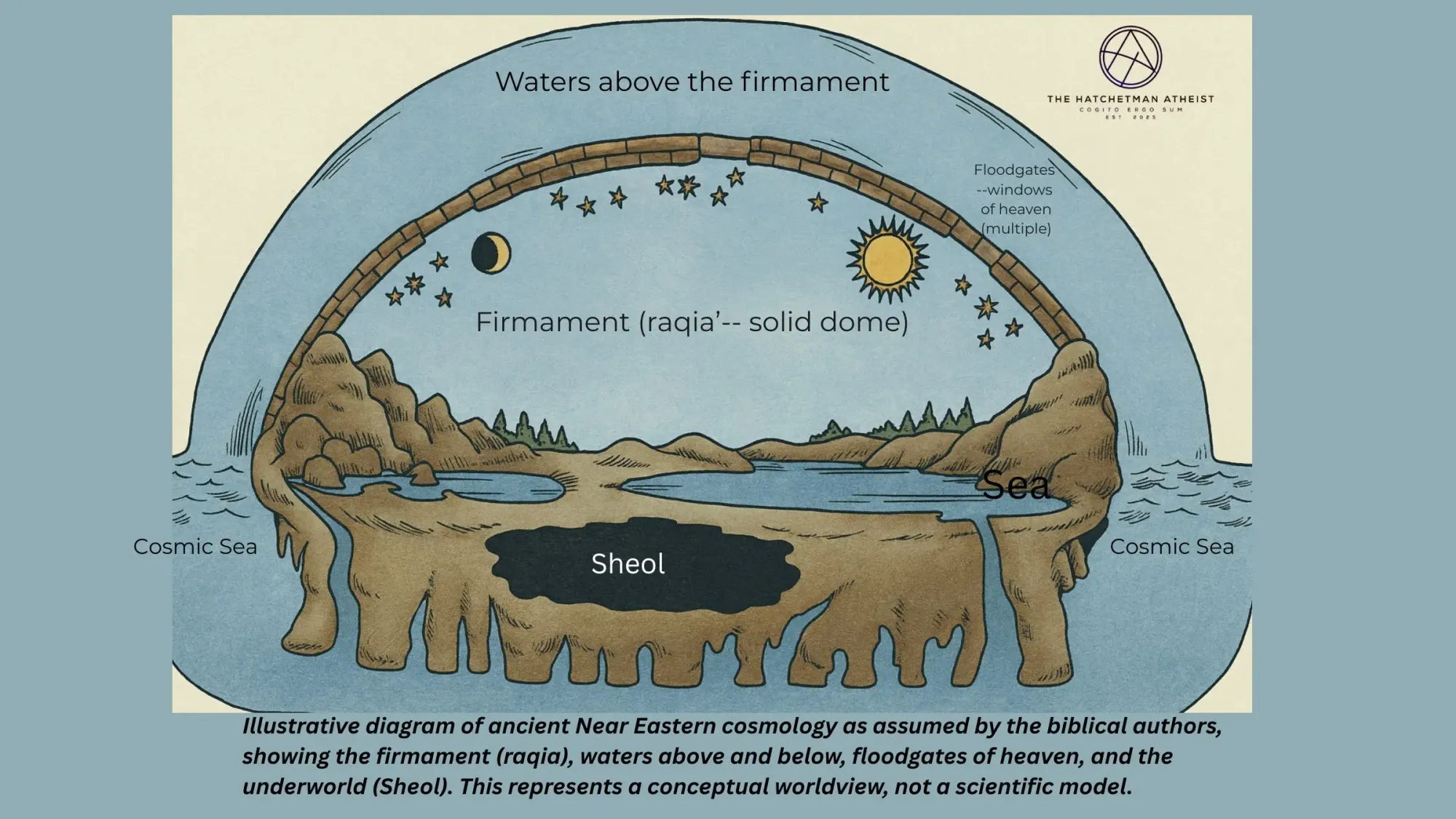
The story of Noah’s Flood does not come from a scientific worldview that failed testing. It comes from a pre-scientific cosmology—one that imagined Earth not as a planet in space governed by gravity and atmospheric circulation, but as a flat landmass carved out of a primordial sea, resting on literal foundations, and sealed beneath a solid dome. The world is less a planet and more a container—closer to a snow globe than a sphere in space.
In this worldview, the universe is structured as follows:
- a primordial sea of chaos
- dry land separated from that sea
- a solid dome (the firmament) placed overhead
- a vast ocean of water above the dome
- literal “windows” or floodgates in the dome
- subterranean waters beneath the land
Rain occurs when God opens literal “windows of heaven.” Floods happen when both the upper waters and the subterranean waters are released at once. Genesis does not describe outer space, gravity, or meteorology. It describes a cosmology inherited directly from the ancient Near East.
This model appears throughout Mesopotamian literature as early as the third millennium BCE and persists—with only minor variations—across Sumerian, Akkadian, Babylonian, and Assyrian traditions. The biblical authors did not invent this worldview; they inherited it.
Noah’s Flood makes internal sense only within this cosmology. Once that cosmology is abandoned—as modern science requires—the flood collapses with it. Treating Genesis literally means accepting its entire cosmology, not selectively discarding the parts that are obviously false while preserving the miracle.
Before the Physics: The World Genesis Assumes
Evidence for a Global Flood Examined
The Problem of Fossil Sorting
If a single, year-long global catastrophe were responsible for Earth’s sedimentary layers, we would expect chaotic mixing and hydrodynamic sorting. In a planet-wide surge of water, fossils would be sorted by density, buoyancy, and drag—not by ecological niche or evolutionary sequence.
Instead, the fossil record shows strict chronological and ecological ordering. We never find flowering plants in Cambrian layers. We never find mammals in the Triassic. Entire ecosystems appear and disappear in consistent, global patterns. A single flood would have blended the history of life into a geological slurry. What we observe instead is a structured archive spanning hundreds of millions of years.
This alone falsifies the global flood model.
Where Would All the Water Come From?
Genesis describes a flood that covered the highest mountains. To do this, global sea level would need to rise roughly 9,000 meters.
Earth’s surface area is approximately 5.1 × 10¹⁴ square meters. Covering it to that depth would require about:
4.6 × 10¹⁸ cubic meters of water.
The total amount of water currently present on Earth—oceans, ice caps, groundwater, and atmospheric moisture combined—is about:
1.4 × 10¹⁸ cubic meters.
Even if every drop of water on the planet were redistributed, it would fall short by more than a factor of three.
Modern apologetic proposals such as vapor canopies or hidden subterranean oceans do not come from Genesis. They are retrofits—modern inventions designed to rescue literalism after the cosmology that supports it has collapsed. The biblical authors imagined literal waters above the sky and below the land because that was how the universe was understood.
There is no physical reservoir capable of supplying a global flood.
Where Would All the Water Go?
Genesis states that the floodwaters receded in roughly 150 days.
Once the entire planet is submerged, there is nowhere for water to drain.
Drainage requires elevation differences: rivers flow into lakes, lakes into seas, seas into basins. A planet-wide ocean has no lower reservoir. The entire surface is already the basin.
Some creationists appeal to “catastrophic plate tectonics,” suggesting rapid mountain uplift and ocean-floor collapse. This merely replaces one impossibility with another. Accelerated tectonics would release immense geothermal energy, trigger global volcanism, and compound the thermal catastrophe rather than resolve it.
Evaporation cannot solve the problem either. Evaporation on this scale would inject even more heat into the atmosphere.
There is no physically plausible mechanism by which a global flood could both occur and then retreat on the timeline described in Genesis.
Rainfall, Energy, and Thermal Collapse
Even granting extremely generous assumptions, the flood fails basic physics.
If only 30 percent of the required floodwater came from rain—a concession far more generous than the biblical text warrants—that still requires approximately 2,700 meters of rainfall in forty days.
That is an average of about 2.8 meters (9 feet) of rain per hour, across the entire surface of the planet, sustained for 960 consecutive hours.
The most extreme rainfall ever recorded on Earth reaches roughly 30 centimeters per hour and lasts minutes to hours over limited regions. No known storm system comes remotely close in either intensity or duration.
But rainfall is constrained not just by water availability. It is constrained by energy.
When water vapor condenses into liquid rain, it releases latent heat. This is a fixed physical property of phase change. At the scale required for a global flood, this heat release would inject energy into the atmosphere at levels thousands of times greater than normal solar heating.
Earlier popular flood calculations often underestimated this problem due to unit-handling errors; correcting those errors makes the thermal contradiction far worse, not better.
The atmosphere would not merely warm. It would be driven into a thermally lethal state.
At such temperatures:
- liquid rain cannot persist
- wooden structures char or ignite
- biological tissue fails catastrophically
The rain itself becomes physically impossible before the flood even completes.
For a separate engineering teardown of the Ark as a wooden vessel, see:
Noah’s Ark and Wooden-Ship Engineering: Why It Wouldn’t Float.
Temperature and Biological Survival
The most immediate and unavoidable biological problem created by a global flood is not drowning. It is heat.
For every kilogram of water that condenses from vapor into rain, approximately 2.26 million joules of energy are released into the surrounding air. Scaling this to the amount of water required for Noah’s Flood produces energy release rates that exceed normal solar heating by orders of magnitude.
As atmospheric temperature rises and humidity approaches saturation, evaporative cooling fails. Sweat no longer cools the body. Panting no longer removes heat. Internal body temperature rises uncontrollably.
Once core body temperature exceeds roughly 41–42 °C, proteins denature, enzymes lose function, and cells fail. This leads rapidly to heat stroke, organ failure, loss of consciousness, and death.
No shade, airflow, or hydration can prevent this once the surrounding air is hot and moisture-saturated. Condensing enough water to flood the planet forces the atmosphere into a state where biological heat dissipation is impossible.
Long before the rain finished falling, land animals—including those on the Ark—would succumb to hyperthermia.
Why Apologetic Explanations Fail
Vapor canopies, underground oceans, altered physics, and accelerated tectonics do not come from Genesis. They exist for one reason only: to preserve literalism after the cosmology that supports it has collapsed.
The biblical authors did not imagine water hidden in alternate dimensions or locked inside minerals. They imagined literal waters above the sky and below the land—because that was how the universe was understood.
The flood story is not false because science is hostile to scripture. It is false because it belongs to a pre-scientific worldview.
See also:
Genesis 1 vs. Science: Why Young-Earth Creationism Fails.
Appendices
Appendix A: Total Water Volume Required for a Global Flood
Surface area of Earth:
5.1 × 10¹⁴ m²
Required flood depth:
9,000 m
Total required volume:
V = A × d
V = (5.1 × 10¹⁴ m²) × (9,000 m)
V ≈ 4.59 × 10¹⁸ m³
Total water currently on Earth (all sources):
≈ 1.386 × 10¹⁸ m³
Deficit:
≈ 3.2 × 10¹⁸ m³
Earth would require more than three times its current water supply to produce a global flood.
Appendix B: Rainfall Rates and Latent Heat Release (Corrected)
Required rainfall rate to reach 9,000 m in 40 days:
9,000 m ÷ 40 days = 225 m/day = 9.375 m/hour
Latent heat of condensation:
L ≈ 2.26 × 10⁶ J/kg
Total water volume required:
4.6 × 10¹⁸ m³
With a density of 1,000 kg/m³, the total mass is:
4.6 × 10²¹ kg
(This corrects a common error in older calculations that mistakenly used grams instead of kilograms.)
Total energy released:
E = (4.6 × 10²¹ kg) × (2.26 × 10⁶ J/kg)
E ≈ 1.04 × 10²⁸ joules
Power output over 40 days (3.456 × 10⁶ seconds):
≈ 3 × 10²¹ watts
Energy per square meter:
≈ 5.9 megawatts/m²
This exceeds incoming solar energy by more than four thousand times and would render both the atmosphere and oceans uninhabitable.
Appendix C: Flood Cosmology in the Ancient Near East
Key terms in the Hebrew text reflect ancient cosmology:
- Raqia — a solid, beaten-out expanse
- Tehom — the primordial abyss
- “Windows of heaven” — literal openings in the dome
Parallel structures appear in Mesopotamian texts such as the Enuma Elish and the Epic of Gilgamesh. The Genesis flood narrative is a theological adaptation of a shared regional cosmology, not a scientific description of planetary events.
Appendix E: Divine Intervention and the Collapse of Historical Explanation
A common response to the physical impossibility of Noah’s Flood is an appeal to divine intervention. When confronted with problems of rainfall, thermodynamics, or biological survival, defenders often assert that God temporarily altered or suspended the laws of nature during the Flood.
This response does not rescue the Flood as a scientific or historical explanation. It changes the category of the claim.
Science and history operate on a shared assumption: that events leave evidence because they occur under the same physical laws that govern the rest of reality. Floods deposit sediments. Volcanoes leave ash layers. Impacts leave craters. These processes are reconstructible precisely because physics behaves consistently.
Once defenders claim that God removed heat, altered rainfall behavior, or suspended biological limits, they concede that the Flood did not operate under the laws of physics as we observe them today.
At that point, physical evidence loses its explanatory power.
Geological strata, fossil distributions, and sedimentary layers can no longer be cited as evidence for the Flood, because those features would no longer reflect natural causal processes. They would instead reflect whatever outcomes God chose to produce during a period when normal physical rules did not apply.
In other words, the moment physics is suspended, geology becomes epistemically mute. The physical record can no longer tell us what happened, because the relationship between cause and effect has been severed.
This has an unavoidable consequence.
If the Flood was miraculous—if the laws of physics were altered or suspended—then science cannot be used to defend it. The Flood becomes immune to scientific investigation, confirmation, or falsification. Creationists therefore have no basis for presenting the Flood as a naturalistic explanation for geological features.
The Flood must be one of two things:
- a natural event, in which case the laws of physics apply and the Flood fails
- a miraculous event, in which case science has nothing to say about it
There is no third option.
Appealing to divine intervention does not answer the scientific objections to Noah’s Flood. It concedes that physical facts today cannot determine what actually happened. At that point, science can pack up and go watch a football game.
Appendix F: Why Retreat Positions Do Not Rescue Literalism
When a literal global flood proves physically impossible, defenders frequently retreat to modified versions of the story. These include claims that mountains were lower at the time of the Flood, that the Flood was global but shallow, that it was “functionally global” from a human perspective, or that it was local but described in universal language.
Each of these retreats abandons the literal reading it seeks to preserve.
Lowering mountains reduces water requirements but does not solve the core physical problems. Even a substantially reduced flood still requires immense water movement, catastrophic rainfall or release mechanisms, and large-scale energy transfer. The same thermodynamic and biological constraints still apply.
None of these claims are stated in the biblical text.
Genesis does not say that mountains were lower, that tectonics behaved differently, or that Earth’s geography was fundamentally altered before or after the Flood. These ideas are introduced solely to rescue the story from physical failure. They are speculative additions with no textual support.
A shallow global flood directly contradicts the text itself, which explicitly states that the highest mountains were covered. Redefining “all the high mountains under the whole heaven” to mean “some local hills” is not literal interpretation. It is reinterpretation.
“Functional global” floods—events that are local but perceived as worldwide by ancient observers—are not literal global floods at all. They are concessions that the narrative reflects limited geographic knowledge rather than planetary events.
Local flood models, while taken seriously in academic biblical scholarship, concede the central issue outright. They treat the Genesis account as a theological adaptation of regional Mesopotamian flooding, not as a worldwide physical catastrophe.
Once these retreats are made, the debate is no longer about whether a literal global flood occurred. It becomes a question of how ancient authors used cosmological and mythic language to frame theological meaning.
The global Flood fails not because critics impose modern science onto an ancient text, but because modern defenders attempt to extract a literal physical event from a cosmology that was never describing one.
Frequently Asked Questions
Is there geological evidence for a global flood?
No. The stratigraphic record shows successive environments over immense timescales, not a single catastrophic layer.
Could the flood have been local?
Yes. Many scholars view the Genesis account as a theological adaptation of Mesopotamian flood traditions likely rooted in large-scale regional flooding of the Tigris–Euphrates basin.
Why do so many cultures have flood myths?
Early civilizations formed along flood-prone rivers. Seasonal flooding was a recurring reality and a natural symbol of destruction and renewal.
How did Noah fit all the animals on the Ark?
From a biological standpoint, he could not. Even reducing animals to “kinds” requires post-flood evolutionary rates far exceeding anything observed in nature.
Further Reading
Flood Origins and Myth Development
- Ancient Flood Myths: Noah and Mesopotamian Origins
- Myth-Information: How the Flood Story Got Bigger, Wetter, and Theologically Deeper
Physical and Engineering Failures
How Evidence Works