Genocidal Massacres at God’s Command: A Biblical Survey
A documented survey of biblical commands to annihilate whole populations—Canaanites and Amalekites included—with full NRSVUE quotations and critical context.

You probably know the basic outline: a group of runaway slaves flees Egypt in spectacular fashion, led by Moses, trudging through the desert for decades toward a “Promised Land.” But the land wasn’t empty. It was home to well-established nations with cities, farms, livestock, and generations of families.
And according to the biblical account, God’s plan wasn’t to negotiate with these people, make peace, or even push them into neighboring territories. The plan was to wipe them out completely. No survivors. No mercy.
From the very start, the instructions are explicit: take the land, kill everyone in it, and destroy everything they own.
Table of Contents
- God’s standing order (Deuteronomy 20:16–17)
- Conquest of Canaan: city-by-city eradication
- “Keep the young girls alive for yourselves” — sexual slavery as war spoils
- The Amalekites: a long memory for vengeance
- Other genocidal commands in the Bible
- Conclusion: ethics and theology
- Related Reading
- Works Cited
God’s standing order (Deuteronomy 20:16–17)
As for the towns of these peoples that the Lord your God is giving you as an inheritance, you must not let anything that breathes remain alive. You shall annihilate them — the Hittites and the Amorites, the Canaanites and the Perizzites, the Hivites and the Jebusites — just as the Lord your God has commanded. (Deut 20:16–17, NRSVUE)
This is not a battlefield pep talk. It’s a standing law. The directive is to completely erase the people who live there — men, women, children, and even animals. For how this posture plays out against rival deities and nations, see That Time When Chemosh Beat Yahweh (Bad).
Conquest of Canaan: city-by-city eradication
Armed with that command, the conquest unfolds like a military logbook of slaughter:
- Numbers 21:3 — Hormah (Canaanites of Arad): The Lord listened to the voice of Israel and handed over the Canaanites, and they utterly destroyed them and their towns; so the place was called Hormah.
- Deuteronomy 2:34 — Sihon’s towns: We captured all his towns at that time and in each town we utterly destroyed men, women, and children; we left not a single survivor.
- Deuteronomy 3:6 — Bashan (Og): We utterly destroyed them, as we had done to King Sihon of Heshbon, in each city utterly destroying men, women, and children.
- Deuteronomy 7:2 — Ban on Canaanites: When the Lord your God gives them over to you and you defeat them, then you must utterly destroy them. Make no covenant with them and show them no mercy.
- Joshua 6:21 — Jericho: Then they devoted to destruction by the edge of the sword all in the city, both men and women, young and old, oxen, sheep, and donkeys.
- Joshua 8:24–25 — Ai: When Israel had finished killing all the inhabitants of Ai in the open wilderness… The total of those who fell that day, both men and women, was twelve thousand, all the people of Ai.
- Joshua 10:28 — Makkedah: He utterly destroyed every person in it; he left no one remaining.
- Joshua 10:30 — Libnah: Every person in it; he left no one remaining.
- Joshua 10:32 — Lachish: He took it on the second day and struck it… every person in it, as he had done to Libnah.
- Joshua 10:35 — Eglon: Every person in it, as they had done to Lachish.
- Joshua 10:37 — Hebron: He left none remaining, just as he had done to Eglon.
- Joshua 10:39–40 — Debir & southern sweep: Utterly destroyed every person in it… he left none remaining but utterly destroyed all that breathed.
- Joshua 11:10–11, 14 — Hazor & northern sweep: They put to the sword all who were in it… there was no one left who breathed… all the people they struck down with the edge of the sword until they had destroyed them.
- Joshua 11:21–22 — Anakim: He utterly destroyed them with their towns. None… was left in the land of the Israelites.
For a broader accounting of violence patterns, see Isaiah 7:14, Micah 5:2, Isaiah 53: No Messianic Prophecies.
For more skeptical deep-dives, read these related posts:
“Keep the young girls alive for yourselves” — sexual slavery as war spoils
Now, therefore, kill every male among the little ones, and kill every woman who has known a man by sleeping with him. But all the young girls who have not known a man by sleeping with him, keep alive for yourselves. (Numbers 31:17–18, NRSVUE)
This was the aftermath of the war against Midian. The text leaves little ambiguity: the captured virgins were war spoils, to be absorbed into the victors’ households — not as wives with choice, but as concubines or servants. For a parallel myth-claim comparison (and why it fails), see Dionysus and Jesus: The Copycat Claim That Doesn’t Hold Water (Or Wine).
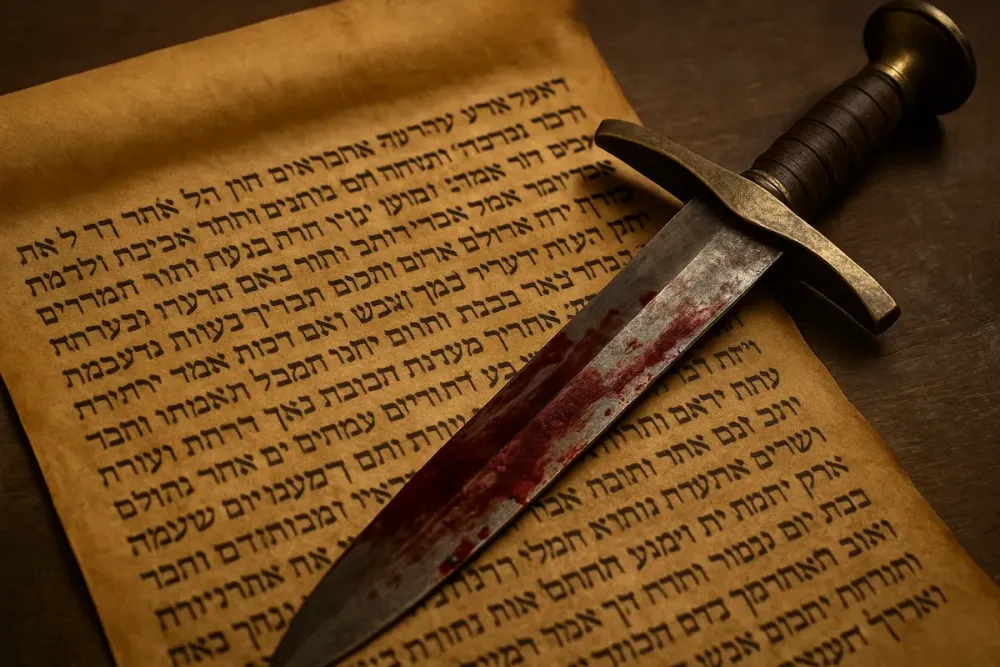
Sword laid over ancient scripture — the fusion of sacred text and sanctioned violence.
The Amalekites: a long memory for vengeance
The Amalekites first appear as desert raiders in the wilderness years. Exodus remembers it this way:
Then the Lord said to Moses, “Write this as a reminder in a book and recite it in the hearing of Joshua: I will utterly blot out the remembrance of Amalek from under heaven.” And Moses built an altar and called it, “The Lord is my banner.” He said, “A hand upon the banner of the Lord! The Lord will have war with Amalek from generation to generation.” (Exod 17:14–16, NRSVUE)
Deuteronomy frames it as a legal memory to fulfill once Israel is settled:
Remember what Amalek did to you on your journey out of Egypt, how he attacked you on the way, when you were faint and weary, and struck down all who lagged behind you; he did not fear God. Therefore when the Lord your God has given you rest from all your enemies on every hand, in the land that the Lord your God is giving you as an inheritance to possess, you shall blot out the memory of Amalek from under heaven; do not forget. (Deut 25:17–19, NRSVUE)
Centuries later, the oath becomes a royal order:
Thus says the Lord of hosts: I will punish the Amalekites for what they did in opposing the Israelites when they came up out of Egypt. Now go and attack Amalek, and utterly destroy all that they have; do not spare them, but kill both man and woman, child and infant, ox and sheep, camel and donkey. (1 Sam 15:2–3, NRSVUE)
Saul kills nearly everyone but spares King Agag and some animals — and that “mercy” costs him the crown. The text’s moral is brutal in its clarity: the sin was not killing; it was not killing enough.
Other genocidal commands in the Bible
- Deuteronomy 13:15–16 — Apostate town: …you shall put the inhabitants of that town to the sword, utterly destroying it and everything in it, even its livestock.
- Deuteronomy 25:19 — Amalek: When the Lord your God has given you rest… you shall blot out the memory of Amalek from under heaven; do not forget.
Conclusion: ethics and theology
These aren’t obscure verses. They are the spine of the conquest narrative. Whether you treat them as literature or history, they portray God as the architect of extermination campaigns, with mercy treated as disobedience. That’s the theological tension believers inherit — and critics won’t stop pointing out.
If you find this work valuable and want to support future research and writing, including research and web-hosting costs, you can do so on patreon.
Works Cited
The Holy Bible, New Revised Standard Version Updated Edition (NRSVUE). National Council of Churches, 2021–2022.